Louis Sass: Phenomenological Psychopathology and the Self
Louis Sass is a clinical psychologist and prominent figure in phenomenological psychopathology. His work bridges clinical psychiatry, philosophy, and cultural analysis. He is best known for his 1992 book Madness and Modernism, which draws striking parallels between the phenomenology of schizophrenia and modernist art, and for co-developing the Ipseity-Disturbance Model (IDM) with Josef Parnas, which posits that schizophrenia is fundamentally a disorder of the "minimal self."
Madness and Modernism (1992)
First published in 1992 and revised in 2017, Madness and Modernism: Insanity in the Light of Modern Art, Literature, and Thought challenged traditional psychoanalytic and biomedical views of schizophrenia. Rather than viewing schizophrenic psychosis merely as a primitive regression, a deficit, or a "loss of reason," Sass proposed that it involves an intense, almost paralyzing heightening of conscious awareness and alienation.[1]
Sass drew extensive parallels between the subjective experience of schizophrenia and the sensibilities of modernist and postmodernist culture.
The similarities between madness and modernism are striking: defiance of convention, nihilism, extreme relativism, distortions of time, strange transformations of self, and much more.[1:1]
Key themes explored in the text include:
-
Hyper-reflexivity and Alienation: Sass compared the schizophrenic experience to the hyper-intellectualized, self-referential works of modernist writers and artists such as Franz Kafka, Samuel Beckett, and Marcel Duchamp.
-
The Truth-Taking Stare: A perceptual anomaly where objects lose their natural context and familiarity, appearing starkly isolated, hyper-real, or pregnant with eerie, unnamable significance.[1:2]
-
Cognitive Slippage and Languages of Inwardness: The fracturing of language and thought, mirroring the dismantling of traditional narrative structures in modern literature.
The Ipseity-Disturbance Model (IDM)
Building upon the philosophical groundwork laid in Madness and Modernism, Louis Sass collaborated with psychiatrist Josef Parnas to formalize the Ipseity-Disturbance Model in their landmark 2003 paper, Schizophrenia, Consciousness, and the Self.[2]
"Ipseity" (from the Latin ipse, meaning "self" or "itself") refers to the experiential sense of being a vital, self-coinciding subject of experience. It is the implicit, first-person perspective on the world—the basic feeling that "I" am the one experiencing my thoughts and actions.[2:1]
According to the IDM, schizophrenia is not primarily a disorder of cognition or perception, but rather a profound disruption of the self at its most fundamental, pre-reflective level. This disturbance is characterized by an intertwined triad of phenomenological anomalies:
-
Hyperreflexivity: An exaggerated, non-volitional self-consciousness. Aspects of oneself (thoughts, bodily sensations, or movements) that are normally inhabited implicitly are objectified and experienced as alien or external phenomena.[2:2]
-
Diminished Self-Affection (Auto-affection): A reduction in the basic sense of self-presence and vitality. The subject loses the foundational feeling of existing as a unified, living center of awareness.[2:3]
-
Disturbed "Hold" or "Grip": As the self fractures, the subject loses their natural, pragmatic "grip" on the external world. Objects no longer stand out in an organized, meaningful field of awareness; reality becomes disjointed, fragmented, or overwhelmingly salient in bizarre ways.[2:4]
Through this framework, classic positive symptoms of schizophrenia (like thought insertion, hallucinations, and delusions of control) are understood not as random brain glitches, but as the logical downstream consequences of hyperreflexivity and diminished self-affection. If a thought loses its "mine-ness" (diminished self-affection) but is still consciously observed (hyperreflexivity), it is experienced as an inserted, alien entity.
Implications for Early Detection and Research
The Ipseity-Disturbance Model has revolutionized how researchers approach the early phases of schizophrenia, particularly in the study of prodromal or Ultra-High Risk (UHR) populations.
-
Trait Markers over State Symptoms: Phenomenologically oriented researchers argue that disturbances of the basic sense of self are the core, psychopathological trait markers of psychotic vulnerability.[3]
-
Early Identification: Traditional psychiatry often relies heavily on overt clinical symptoms (like hallucinations). The IDM suggests that anomalous self-experiences (Self-Disorders or SDs) are present much earlier, often in childhood or adolescence. Identifying these subtle shifts in subjective experience can help clinicians reduce "false-positives" in UHR cohorts and intervene before full-blown psychosis develops.[3:1]
-
Ongoing Relevance: More than twenty years after its conceptualization, the IDM remains a vital, evolving framework in psychiatric research, offering a theoretically informed and empirically tractable method for indexing genetic liability to the schizophrenia spectrum.[4]
Resonant Notes
The following notes in this vault resonate with the themes of phenomenological psychopathology, the Ipseity-Disturbance Model, hyperreflexivity, diminished self-affection, and the parallels between schizophrenia and modernist art explored above:
-
Freud's The Uncanny (Das Unheimliche) — Freud's foundational psychoanalytic essay on the uncanny provides the theoretical framework for the "truth-taking stare" and the experience of the familiar becoming strange. Sass's phenomenological account of schizophrenia — where objects lose their natural context and loom with eerie significance — is a clinical instantiation of the Freudian uncanny: the return of the repressed, the unhomely made perceptual.
-
The Failure of the Map-Art, the Uncanny, and the Divided Brain — The vault's closest companion piece. Examines depersonalization as the purest manifestation of the uncanny — the flattened, disconnected experience of reality when the left hemisphere's categorical computing fails. This maps directly onto Sass's hyperreflexivity and the "truth-taking stare," where objects lose their natural context and appear starkly isolated. McGilchrist's clinical observations of schizophrenia as hyper-rationalism and right-hemisphere deficit parallel Sass's phenomenological model.
-
Gestalt and Buddhism-Reality Construction — Discusses the constructed nature of selfhood, Metzinger's Self-Model Theory, and the collapse of the self-model in depersonalization and psychopathology. Directly resonates with the IDM's account of diminished self-affection — the loss of the basic feeling of being a unified subject of experience.
-
The Matter With Things Analysis — McGilchrist's analysis of schizophrenia as a catastrophic deficit in right-hemisphere contextual integration, producing fragmented perception and hyper-rational doubt about one's own existence. The divided brain thesis provides the neuroscientific architecture that complements Sass's phenomenological framework.
-
Franz Kafka — Sass explicitly cites Kafka as a key parallel to schizophrenic experience: hyper-intellectualized alienation, the fracturing of self, and the experience of being trapped in an opaque, irrational system. Kafka's bodily estrangement in The Metamorphosis is a literary case study of the kind of self-disorder Sass describes.
-
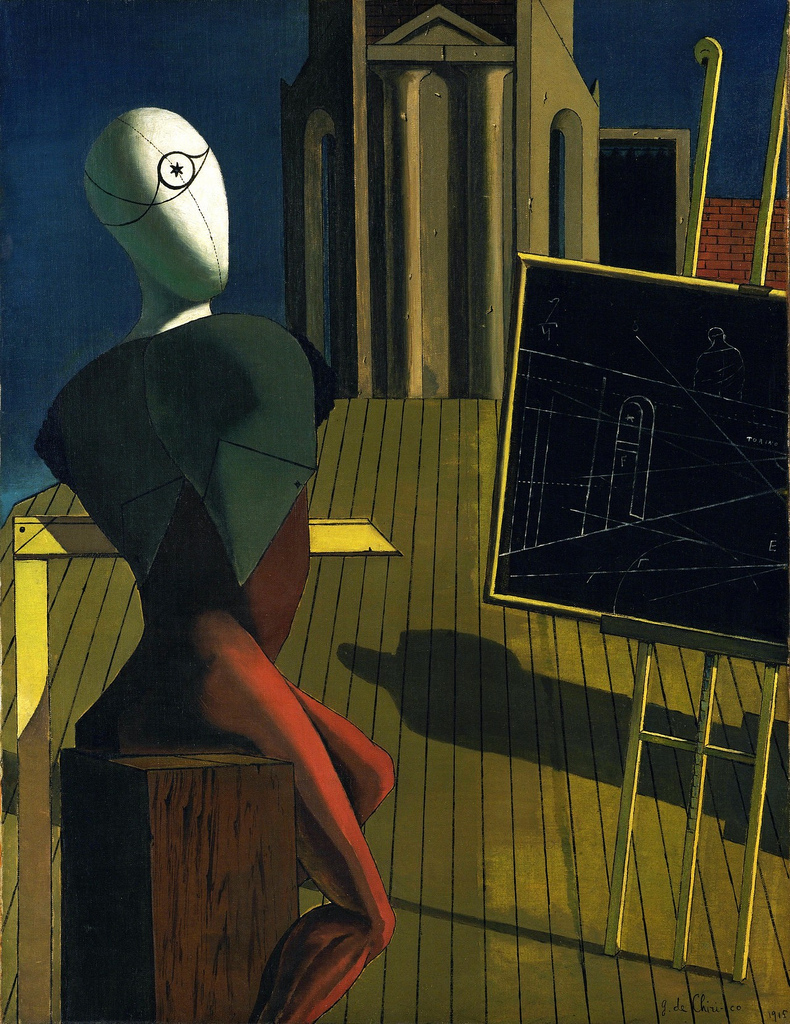
Giorgio de Chirico — De Chirico's Pittura Metafisica — deserted arcades, distorted perspectives, faceless mannequins — is the visual art movement that most directly embodies the "truth-taking stare" and the uncanny perceptual world Sass analyzes: objects stripped of context, looming with eerie, unnamable significance.
-
The Psychology and Sociology of Estrangement-The Uncanny and Alienation — Covers the uncanny (das Unheimliche), alienation (Entfremdung), and defamiliarization — the experiential territory Sass describes in schizophrenia: the familiar becoming strange, the loss of the natural "hold" on reality.
-
Don DeLillo Major Themes Analysis — DeLillo's themes of hyper-consciousness, media saturation, and the colonization of consciousness by external systems resonate with Sass's hyperreflexivity — the exaggerated, non-volitional self-consciousness that turns lived experience into an object of alien observation.
-
Constructs of the Mind-Unmasking Consciousness in East and West — Jung and Nāgārjuna on the ego, consciousness, and psychosis. Jung's warning that eliminating the ego leads to psychosis rather than enlightenment directly engages with the same territory as Sass's IDM — what happens when the minimal self is disrupted.
-
Jacques Lacan — Lacan's Mirror Stage, foreclosure of the Name-of-the-Father, and theory of psychosis provide a psychoanalytic framework that complements Sass's phenomenological approach to self-disorder.
-
Aldous Huxley's Heaven and Hell (1956) — Huxley's "Infernal Antipodes" and the parallel between the bad trip and chronic schizophrenia directly engage with the phenomenology of psychosis Sass analyzes. The "reducing valve" theory of the brain as a filter that can fail resonates with Sass's account of hyperreflexivity.
-
Iain McGilchrist — The person note for McGilchrist, whose divided brain thesis provides the neuroscientific architecture that aligns with Sass's phenomenological model of schizophrenia as a disorder of the minimal self.
-
Anthony Vidler-The Architectural Uncanny — Vidler's analysis of the architectural uncanny — where the familiar home becomes strange and alienating — parallels the clinical phenomenon Sass describes in schizophrenia. The "truth-taking stare" (objects stripped of context, looming with eerie significance) is the perceptual equivalent of Vidler's unhomely space. Both diagnose the same loss of the natural "hold" on reality, one through architecture, the other through psychopathology.
References
Backlinks
- Martin Heidegger — Sass's Ipseity-Disturbance Model draws on Heidegger's Dasein analysis to understand schizophrenia as a disorder of the minimal self.
“Schizophrenia, Consciousness, and the Self” Twenty Years Later_ / Oxford Academic
Louis Sass / Madness and Modernism - Oxford University Press / OUP ↩︎ ↩︎ ↩︎
Louis Sass and Josef Parnas / Schizophrenia, Consciousness, and the Self / Oxford Academic ↩︎ ↩︎ ↩︎ ↩︎ ↩︎
Nelson et al. / The Phenomenological Critique and Self-disturbance: Implications for Ultra-High Risk Research / Oxford Academic ↩︎ ↩︎
Andrea Raballo et al. / _ ↩︎