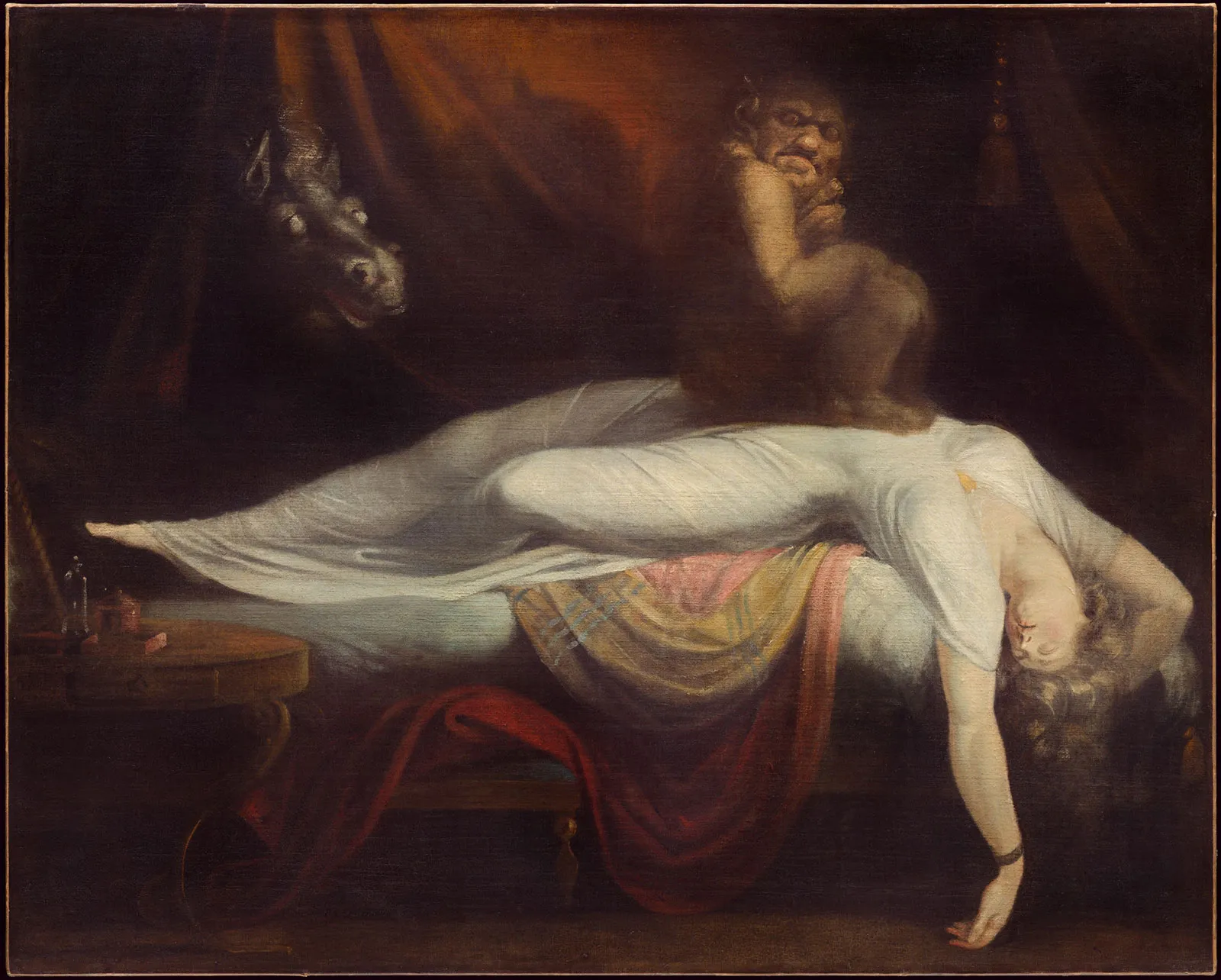
The Nightmare (1781) is a seminal oil painting by Swiss-English artist Henry Fuseli. Renowned for its horrifying and erotic evocation of sleep paralysis and the subconscious mind, the piece shocked 18th-century audiences. It eschewed traditional moral or historical themes in favor of raw psychological exploration, effectively becoming a defining masterpiece of Gothic Romanticism.[1]
Artwork Metadata
-
Artist: Henry Fuseli (born Johann Heinrich Füssli)
-
Year: 1781
-
Medium: Oil on canvas
-
Dimensions: 101.6 cm × 127 cm (40.0 in × 50.0 in)[2]
-
Location: Detroit Institute of Arts, Detroit, Michigan[3]
Visual Description and Technique
The composition centers on a woman in deep, troubled sleep. She is draped unnaturally over the end of a bed with her head and arms hanging down, exposing her long neck in a position of complete physical vulnerability.[1:1] Fuseli utilizes a stark chiaroscuro technique, illuminating the woman's lifeless-seeming body in bright white light while plunging the rest of the bedroom into oppressive, heavy tones of dark red, yellow, and ochre.[4]
Two terrifying entities emerge from the shadows to dominate the canvas:
-
The Incubus: A demonic, ape-like creature crouches directly upon the sleeping woman's chest. Rather than looking at her, it stares out confrontationally at the viewer.[5]
-
The Horse: A spectral horse with glowing, vacant eyes and flared nostrils bursts through the velvet curtains in the background, serving as a literal visual pun for the "night-mare."[5:1]
The painting is a masterclass in the Gothic concept of the sublime—an overwhelming feeling of awe mixed with profound terror. Unlike most art exhibited at the Royal Academy during the Enlightenment era, The Nightmare offered no moral, religious, or literary lesson, choosing instead to focus purely on visceral shock value.[4:1]
Thematic Interpretations
Folklore and Etymology
The painting draws heavily from Germanic and Scandinavian folklore. In Scandinavian mythology, a mara was a malevolent spirit sent to suffocate or torment sleepers.[1:2] The image visually represents the physiological experience of sleep paralysis, historically referred to as "hag-riding" or "mare-riding." Sufferers of this condition often report a crushing weight on their chest, difficulty breathing (dyspnea), and an overwhelming sense of dread, perfectly mirroring the incubus sitting upon the woman's torso.[1:3]
Psychoanalytic Anticipation
Working during the height of the "Age of Reason," Fuseli chose to depict irrational, darker forces. His work is widely considered a precursor to late 19th-century psychoanalytic theories regarding dreams and the subconscious.[5:2] By illustrating a dream taking physical, monstrous form, the painting scandalized critics with its overt, albeit symbolic, sexuality. Decades later, Sigmund Freud reportedly kept a reproduction of the painting on the wall of his apartment in Vienna.[5:3]
Biographical Context
Art historians suggest a deeply personal, darker motivation behind the canvas. During its creation, Fuseli was coping with an unrequited romance and a rejected marriage proposal to a woman named Anna Landolt, who subsequently married a family friend.[1:4]
Some scholars interpret the painting as an expression of Fuseli's frustrated sexual desires and romantic bitterness—positing that the sleeping woman is Landolt, and the incubus is a projection of Fuseli himself.[4:2] Supporting this theory is an unfinished portrait of a young girl on the reverse side of the original canvas, widely believed to be Landolt.[1:5]
Cultural Impact and Legacy
Upon its exhibition at the Royal Academy of London in 1782, critics reacted with "horrified fascination."[1:6] The painting propelled Fuseli to commercial fame, leading to multiple alternate versions painted by Fuseli himself, widely distributed engraved copies, and even satirical political cartoons.[1:7]
The painting also left an indelible mark on 19th-century Gothic literature:
-
Mary Shelley’s Frankenstein: The iconic scene in which the monster murders Victor Frankenstein's bride, Elizabeth, directly mirrors the visual staging of Fuseli's painting: "She was there, lifeless and inanimate, thrown across the bed, her head hanging down..."[1:8]
-
Edgar Allan Poe: In his 1839 short story The Fall of the House of Usher, Poe's narrator explicitly compares a painting in Usher's house to Fuseli's work, noting that he felt "upon my heart an incubus of utterly causeless alarm."[1:9]
Resonant Notes
The following vault notes resonate with the themes and artistic context of The Nightmare:
-
Romantic Literature Themes Analysis — Fuseli's painting is a defining masterpiece of Gothic Romanticism, embodying the movement's fascination with the sublime, the irrational, and the psychological depths of the human mind.
-
Freud's The Uncanny (Das Unheimliche) — Fuseli's painting anticipates Freud's psychoanalytic framework for the uncanny: the return of the repressed in symbolic, monstrous form. The incubus on the sleeper's chest is a visual precursor to Freud's analysis of the uncanny as the familiar made terrifyingly alien — the repressed desire or trauma that surfaces when rational consciousness is suspended.
-
The Sleep of Reason Produces Monsters — Fuseli's The Nightmare and Goya's etching share a common theme: the terrifying visions that emerge when rational consciousness is suspended. Both works explore the Gothic concept of the sublime — awe mixed with profound terror.
-
Goethe's Faust — Both Fuseli's painting and Goethe's Faust emerged from the Sturm und Drang movement, exploring the dark, irrational forces that lurk beneath the surface of Enlightenment reason.
-
From Walls of Wood to Walls of Glass - Northrop Frye’s Geography of Isolation — The painting's depiction of the sleeping woman's vulnerability and the incubus's domination can be read through Frye's garrison mentality — the precarious boundary between the protected self and the threatening wilderness of the unconscious.
References
Wikipedia Contributors / The Nightmare / Wikipedia ↩︎ ↩︎ ↩︎ ↩︎ ↩︎ ↩︎ ↩︎ ↩︎ ↩︎ ↩︎
Google Arts & Culture / The Nightmare - Henry Fuseli / Google Arts & Culture ↩︎
TheCollector / The Nightmare by Henry Fuseli: 3 Ways to Interpret His Most Famous Work / TheCollector ↩︎ ↩︎ ↩︎
Khan Academy / The Nightmare by Henry Fuseli / Khan Academy ↩︎ ↩︎ ↩︎ ↩︎