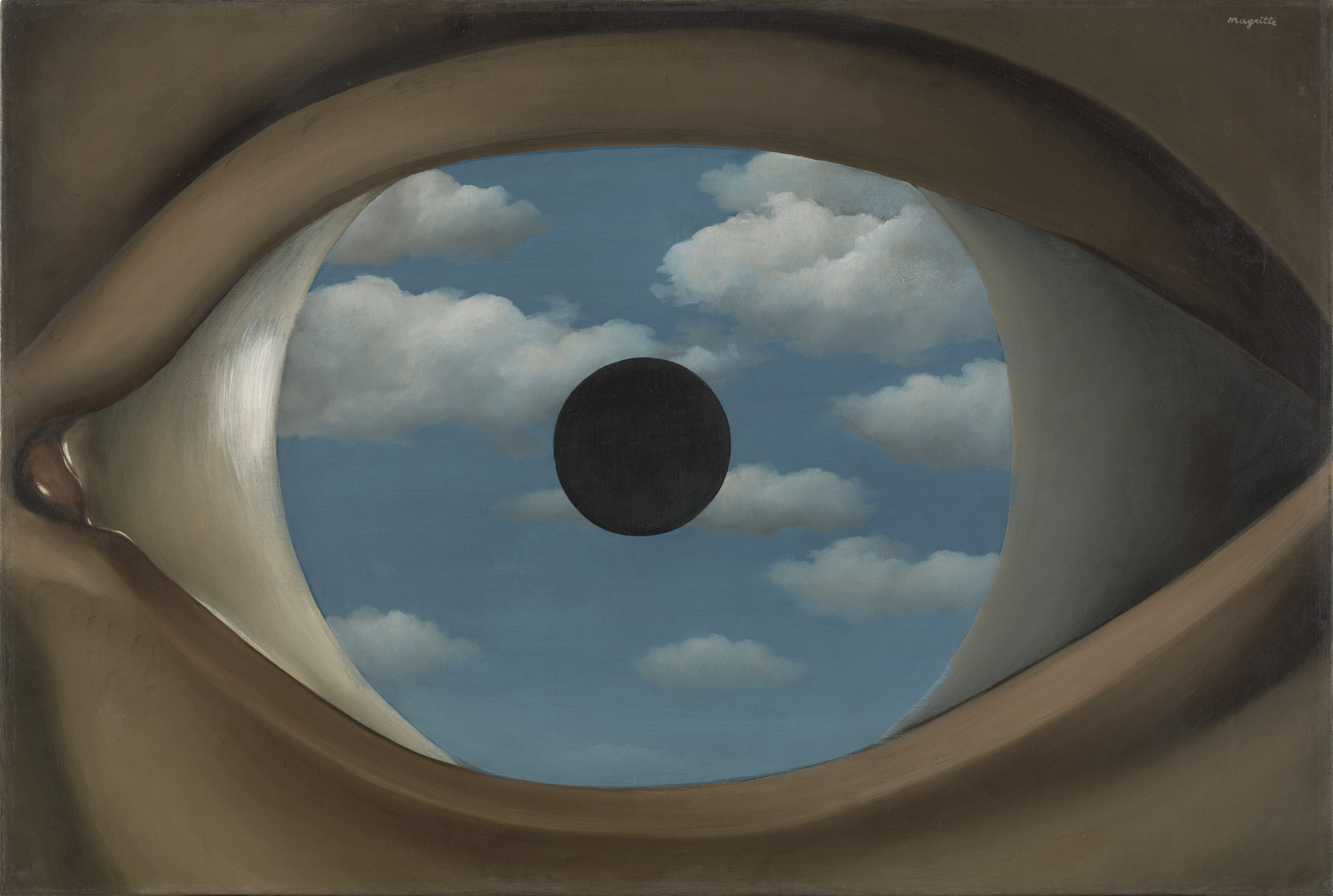
René Magritte: The Philosophy of the Ordinary
René Magritte (1898–1967) was a pioneering Belgian Surrealist painter who utilized a precise, illustrative painting style to subvert human perception. By placing ordinary objects—such as bowler hats, green apples, and pipes—in impossible or contradictory contexts, Magritte challenged the fundamental nature of representation and reality, deeply influencing the trajectories of Pop Art, Conceptual Art, and postmodern philosophy.
The Philosophy of the Ordinary
Unlike Surrealists such as Salvador Dalí, who relied on distorted, dream-like hallucinations and automatism, René Magritte approached the subconscious through cold, naturalistic clarity. He deliberately pursued a figurative, almost deadpan style to create visual paradoxes that would, in his own words, "challenge the real world."[1]
Magritte sought to sever the link between surface appearance and essence. He achieved this through a process of displacement—removing familiar objects from their expected contexts and placing them in uncanny arrangements. His goal was to make the most everyday objects "shriek aloud," forcing the viewer to confront the unreliability of their own sensory perception.[2] By painting ordinary things (a cloudy sky, a glass of water, a comb) with mundane precision, he highlighted the cognitive dissonance that occurs when reality fails to behave according to physical laws.
Key Motifs in Magritte's Vocabulary
Magritte’s visual language functioned almost like a cryptic alphabet. He reused specific objects repeatedly, though their meaning remained intentionally unstable across different works:
-
Green Apples: Often used to obstruct vision or play with scale, signifying the tension between the visible and the hidden.
-
Bowler Hats: A symbol of the anonymous, middle-class everyman, representing an erasure of individuality.
-
Skies and Clouds: Frequently framed within eyes, mirrors, or silhouettes, blurring the line between interior and exterior spaces.
-
Curtains and Windows: Theatrical devices used to confuse the boundary between looking at the real world and looking at a painted picture.[3]
A common biographical interpretation of Magritte's work links the recurring motif of shrouded or obscured faces (as seen in The Lovers) to the tragic suicide of his mother in 1912. Her body was pulled from the River Sambre with her nightgown purportedly wrapped around her face. Magritte adamantly rejected this psychoanalytic interpretation, insisting his paintings were inherently mysterious and meant nothing specific.[4]
Masterpieces and Critical Analysis
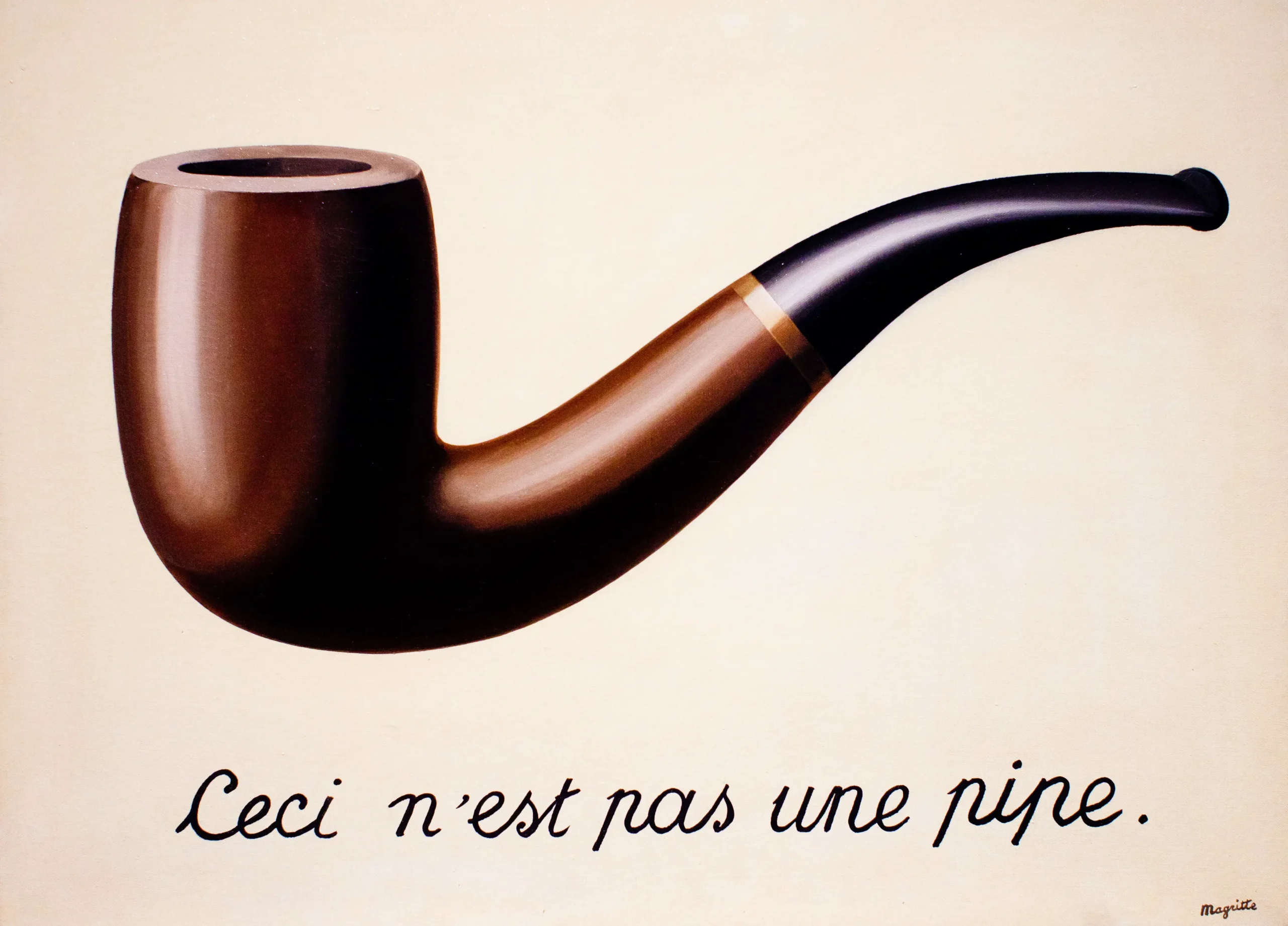
The Treachery of Images (1929)
Perhaps his most philosophically enduring work, The Treachery of Images depicts a highly realistic pipe hovering above the cursive text: "Ceci n'est pas une pipe" ("This is not a pipe"). This piece serves as an artistic manifesto against literal interpretations of visual art. It generates immediate cognitive friction by dividing a single concept into two conflicting signs (verbal and visual).[5] Magritte exposes the "efficient error" of human perception, reminding the viewer that a painted representation of an object can never truly be the object itself—a foundational concept for structuralist linguistics and modern media theory.
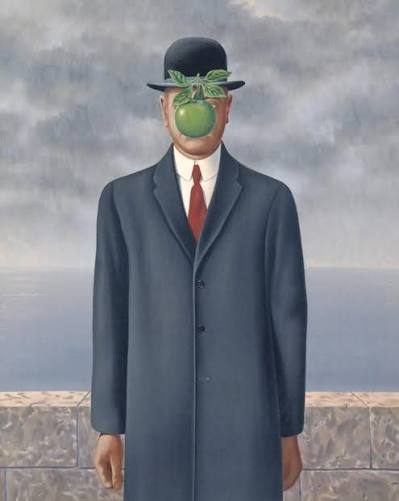
The Son of Man (1964)
Painted late in his career, The Son of Man acts as a subversion of traditional portraiture. The painting features a rigidly standing man in a bowler hat, his face almost entirely obscured by a hovering green apple, save for a single eye peeking out. The portrait offers all the visual signals of personal identity, only to deny the viewer the expected revelation of the subject's face.[6] It functions as a meditation on human curiosity and the inherent frustration of concealment, capturing the perpetual conflict between what is visible and what is hidden by the visible.
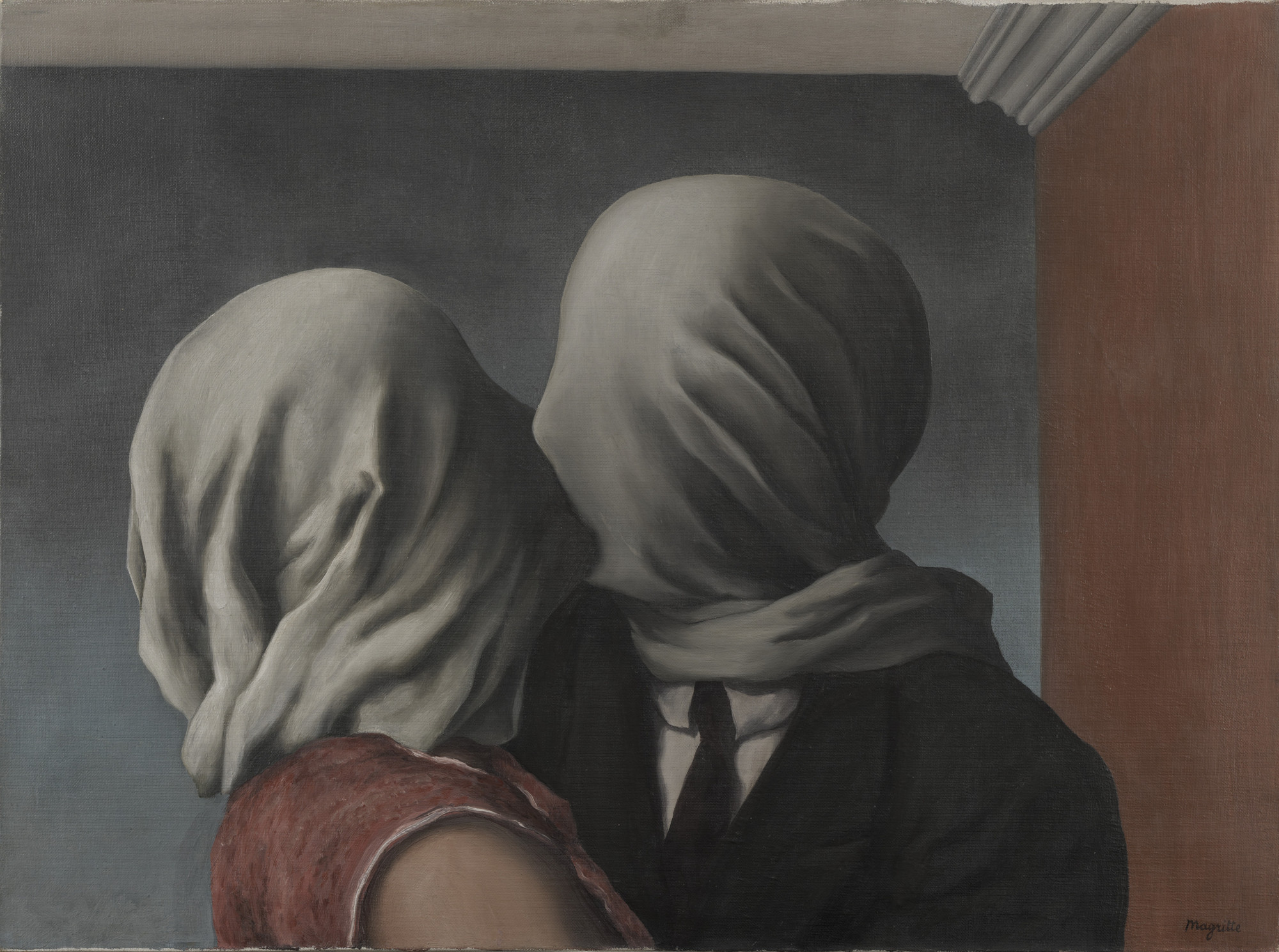
The Lovers (1928)
The Lovers portrays two figures locked in an embrace, their faces completely shrouded in white cloth as they attempt to kiss. The barrier of fabric transforms a passionate, intimate act into one of profound isolation, blindness, and frustration. It is a striking visual representation of thwarted desire and the ultimate unknowability of even our most intimate companions.[7]
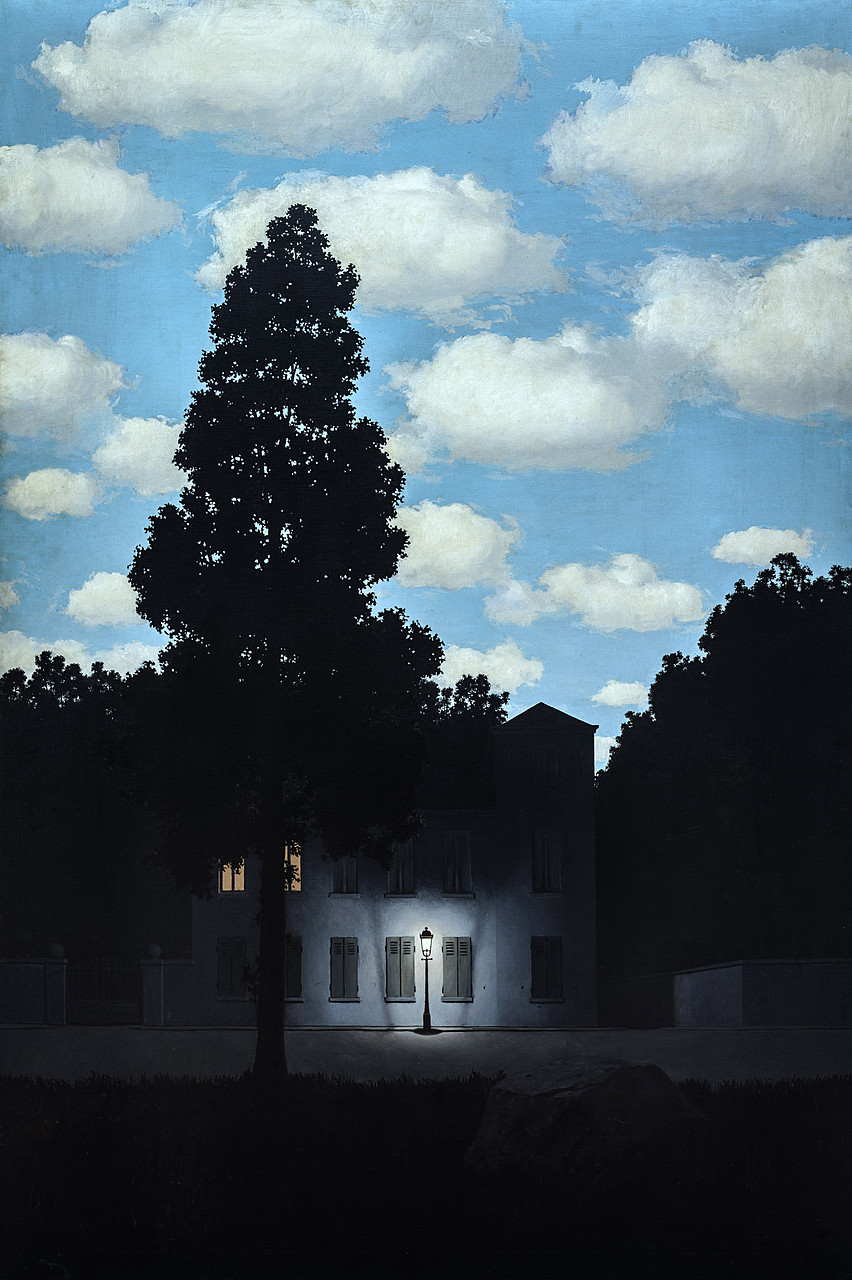
The Empire of Light Series (1950s)
In this extensive series, Magritte juxtaposes a serene, cloud-filled daytime sky with a dark, shadowy street scene illuminated by a single streetlamp. By unifying two mutually exclusive states of time—day and night—into a single, seamlessly painted landscape, the image creates a haunting, quiet impossibility that defies rational logic while maintaining visual harmony.[8]
Legacy and Influence on Contemporary Art
Magritte's intellectualized approach to painting—particularly his exploration of the gap between a word, an image, and an object—broke out of the confines of traditional Surrealism. His visual vocabulary leaked heavily into popular culture, graphic design, and advertising.
Magritte is largely considered a vital bridge between early 20th-century Surrealism and post-war artistic movements. By shifting the focus of art from what an image depicts to how an image functions, he laid the groundwork for Conceptual Art.
His influence is heavily documented in the works of Pop and Conceptual artists of the 1960s and beyond. Artists such as Andy Warhol, Jasper Johns, Ed Ruscha, and John Baldessari heavily appropriated Magritte's subversive juxtaposition of text and image, his flat aesthetic, and his critique of mass-produced reality.[9] In an increasingly digital world saturated with symbols and representations often mistaken for reality, Magritte's "treacherous" images remain a vital tool for philosophical skepticism.
Resonant Notes
The following notes in this vault resonate with Magritte's themes of representation vs. reality, the uncanny, cognitive dissonance, semiotics, and the defamiliarization of the ordinary:
-
Freud's The Uncanny (Das Unheimliche) — Magritte's method of displacement — removing familiar objects from expected contexts to make them "shriek aloud" — is a direct artistic application of the Freudian uncanny. His paintings stage the return of the repressed in visual form: the familiar rendered alien, the homely made strange, the everyday object suddenly charged with unnamable significance.
-
The Failure of the Map-Art, the Uncanny, and the Divided Brain — Magritte's The Treachery of Images is a direct artistic statement that representation is not reality, paralleling McGilchrist's claim that the left hemisphere mistakes its abstract models for the living territory.
-
The Psychology and Sociology of Estrangement-The Uncanny and Alienation — Provides the theoretical framework for the uncanny and defamiliarization (ostranenie) that Magritte's displacement method embodies — making the familiar "shriek aloud" to provoke epistemological doubt.
-
Giorgio de Chirico — The direct artistic precursor to Magritte; de Chirico's Pittura Metafisica established the visual vocabulary of the uncanny that Magritte would later adapt. Magritte called seeing de Chirico's The Song of Love one of the most moving moments of his life.
-
Cognitive Dissonance — Magritte's paintings are perfect case studies of Festinger's theory: The Treachery of Images generates immediate cognitive friction by presenting two inconsistent cognitions simultaneously ("this is a pipe" vs. "this is not a pipe").
-
Defining a Simulacrum — Baudrillard's hyperreality is the philosophical endpoint of Magritte's project: if The Treachery of Images warns us that a painted pipe is not a pipe, Baudrillard describes a world where we have forgotten the warning entirely and mistake the copy for the original.
-
Jacques Lacan — Lacan's primacy of the signifier and the gap between the Imaginary and the Real provide the theoretical language for understanding Magritte's word/image juxtapositions, where meaning glides without ever stabilizing.
-
Gestalt and Buddhism-Reality Construction — Explores how the brain constructs a unified reality from fragmented inputs — the very mechanism Magritte exploits by shattering the transparency of perception and forcing the viewer to confront the gap between representation and reality.
-
Anthony Vidler-The Architectural Uncanny — Magritte's method of displacement — removing familiar objects from expected contexts to make them "shriek aloud" — parallels Vidler's analysis of how architecture defamiliarizes domestic space. Both explore the uncanny as a disruption of the familiar that reveals the fragility of our representational systems.
Backlinks
- The Failure of the Map-Art, the Uncanny, and the Divided Brain — Magritte's The Treachery of Images ("Ceci n'est pas une pipe") is a direct artistic statement that representation is not reality — paralleling McGilchrist's claim that the left hemisphere mistakes its abstract models for the living territory, and generating the uncanny through this cognitive friction.
References
Museum of Modern Art / René Magritte Biography / moma.org ↩︎
Anne Umland / Magritte: The Mystery of the Ordinary, 1926-1938 / moma.org ↩︎
The History of Art / René Magritte: Belgian Surrealist Painter / thehistoryofart.org ↩︎
Museum of Modern Art / René Magritte. The Lovers. Paris 1928 / moma.org ↩︎
Zen Museum / The Treachery of Images: Magritte's Pipe, Reality, Language / zenmuseum.com ↩︎
The History of Art / The Son of Man by Rene Magritte / thehistoryofart.org ↩︎
Sotheby's / René Magritte: Biography, Art Style & Works / sothebys.com ↩︎
Museum of Modern Art / René Magritte Juxtaposed Scenes / moma.org ↩︎
CODART / Magritte and Contemporary Art: The Treachery of Images / codart.nl ↩︎