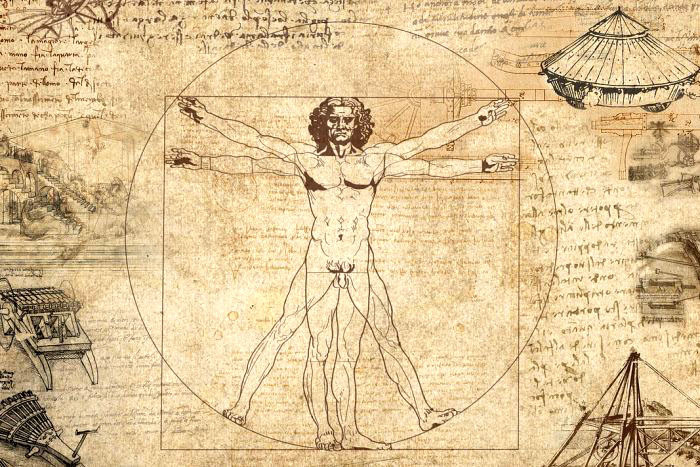
The Renaissance
> [!summary] >The Renaissance (French for "rebirth") was a profound cultural, intellectual, and artistic movement in Europe that bridged the Late Middle Ages and the early modern period. Originating in the Italian city-states during the 14th century, it was characterized by a revival of classical Greco-Roman philosophy, art, and literature. While standard narratives focus on artistic triumphs, the period was fundamentally driven by radical innovations in economics, the democratization of information via the printing press, and a divergence in philosophical thought between the Italian city-states and Northern Europe.
Origins and Historical Context
The Renaissance emerged in the wake of significant European upheavals, including the Black Death, the Hundred Years' War, and widespread political instability.[1] By the late 14th and 15th centuries, as these crises stabilized, expanding Afro-Eurasian trade networks brought unprecedented wealth into Italian city-states like Florence, Venice, and Genoa.[1:1]
This influx of wealth led to the rise of a powerful merchant and banking elite. These elites acted as patrons, pouring massive amounts of capital into the arts and cultural development.[2] Furthermore, the fall of Constantinople in 1453 drove many Greek scholars to migrate to Italy, bringing with them ancient texts that fueled the intellectual revival.[3]
Economic Foundations and the Commercial Revolution
The cultural explosion of the Renaissance was not merely an intellectual awakening; it was underwritten by a massive accumulation of capital and new financial technologies in the Italian city-states.
The Invention of Modern Finance
The wealth that funded the Renaissance was managed through revolutionary economic tools. The most significant was the codification of double-entry bookkeeping. Formally published by Franciscan friar and mathematician Luca Pacioli in his 1494 work Summa de arithmetica, this system allowed merchants to track complex international transactions, manage credit, and assess profitability with unprecedented accuracy.[4]
The Medici Bank and Patronage
Founded in 1397 by Giovanni di Bicci de' Medici, the Medici Bank became the largest and most respected institution in Europe, operating branches in Rome, Venice, Geneva, and London.[5]
-
Letters of Credit: The bank popularized the use of letters of credit, which allowed merchants to deposit money in one city and withdraw it in another, vastly reducing the physical risk of transporting gold across bandit-ridden European roads.
-
Political Power: This immense wealth allowed the Medici family (particularly Cosimo and Lorenzo the Magnificent) to become the de facto rulers of Florence, using their capital to commission works as a display of civic power and personal prestige.[5:1]
The Two Renaissances: Civic and Christian Humanism
At the heart of the Renaissance was Humanism, a philosophy that emphasized the potential, agency, and achievements of the individual. Derived from the Roman concept of humanitas, it shifted focus away from the strictly religious worldview of the Middle Ages toward worldly and practical pursuits.[3:1]
As Renaissance ideals spread across the Alps in the late 15th century, they adapted to the distinct cultural and political realities of Northern Europe, creating two distinct movements.
The Italian Renaissance (Civic Humanism)
-
Focus: Heavily secular, deeply concerned with reviving classical Greco-Roman antiquity, and focused on civic virtue and individual potential.
-
Artistic Hallmarks: Frescoes, tempera, idealized human anatomy, and linear perspective.
-
Key Text: Giovanni Pico della Mirandola’s Oration on the Dignity of Man (1486), often called the "Manifesto of the Renaissance," which argued that humans have no fixed place in the universal hierarchy and can elevate themselves through free will and intellect.[6]
"We have made you a creature neither of heaven nor of earth, neither mortal nor immortal, in order that you may, as the free and proud shaper of your own being, fashion yourself in the form you may prefer."
The Northern Renaissance (Christian Humanism)
-
Focus: While Italian humanists studied pagan antiquity, Northern humanists applied the same linguistic and textual analysis to early Christian texts, the writings of the Church Fathers, and the Bible.[7] Their goal was social reform and the purification of the Catholic Church.
-
Artistic Hallmarks: The perfection of oil painting (pioneered by Jan van Eyck), extreme hyper-realism, and a focus on domestic interiors, landscapes, and peasant life rather than idealized classical gods.
Key Figures of the Renaissance
The period produced a staggering array of intellectuals, artists, and innovators whose influence remains central to Western culture.[8]
Art and Architecture
-
Filippo Brunelleschi (1377–1446): Pioneered one-point linear perspective and engineered the massive dome of the Florence Cathedral.[8:1]
-
Leonardo da Vinci (1452–1519): The quintessential "Renaissance Man," known for masterworks like the Mona Lisa and The Last Supper, as well as his detailed anatomical and engineering sketches.[8:2]
-
Michelangelo Buonarroti (1475–1564): A master sculptor and painter whose works, including the statue of David and the ceiling of the Sistine Chapel, glorified the human form.[8:3]
-
Raphael Sanzio (1483–1520): Famed for his perfection and grace in works like The School of Athens, which visually encapsulated the humanist revival of classical philosophy.[8:4]
Literature and Political Philosophy
-
Niccolò Machiavelli (1469–1527): Authored The Prince, fundamentally shifting political science by stressing pragmatism ("it is safer to be feared than to be loved") over moral idealism.
-
Desiderius Erasmus (1466–1536): A key figure of the Northern Renaissance who published a critical Greek edition of the New Testament (1516). He used humanist principles to critique the corruption of the Catholic Church, inadvertently laying the groundwork for the Reformation.[7:1]
The Information Revolution: The Printing Press
The intellectual shifts of the Renaissance would have remained isolated among the elite without the invention of the mechanical movable-type printing press by Johannes Gutenberg in Mainz, Germany, around 1440.[9]
Before the printing press, a scribe could produce perhaps a few pages a day. By the early 1500s, a single printing press could produce 3,600 pages a day.
-
Explosion of Texts: By 1500, printing presses had been established in over 200 cities across Europe, producing an estimated 20 million volumes. By 1600, that number rose to roughly 200 million.[9:1]
-
Vernacular Literature: The press made it profitable to print books in local languages (vernaculars) rather than just Latin, standardizing languages and fostering a new reading public among the emerging middle class.
The Scientific Renaissance (1543)
While the early Renaissance was dominated by art and philosophy, the later period saw a radical transformation in how humanity understood the physical universe, culminating in the year 1543, which saw the publication of two world-altering texts:[10]
-
Macrocosm (Astronomy): Nicolaus Copernicus published De revolutionibus orbium coelestium (On the Revolutions of the Heavenly Spheres). Relying on mathematics rather than theological dogma, he proposed a heliocentric model of the universe, displacing Earth from the center of creation.
-
Microcosm (Anatomy): Andreas Vesalius published De humani corporis fabrica (On the Fabric of the Human Body). By performing human dissections himself, Vesalius revolutionized the study of human anatomy through direct empirical observation.
Both Copernicus and Vesalius demonstrated the ultimate Renaissance intellectual shift: moving away from unquestioning reliance on ancient authority and toward direct, empirical observation and mathematical proof.
Global Integration and Legacy
While often portrayed as a strictly European phenomenon, the Renaissance was deeply interconnected with global networks. The artistic and technological breakthroughs of the era relied heavily on Afro-Eurasian trade. New pigments for painting were sourced from Central and South Asian minerals, while foundational technologies for the printing press (like moveable type and papermaking) had their origins in China and the Islamic world.[1:2]
The era also coincided with the Age of Exploration. Driven by the desire to secure direct trade routes for spices and gold without going through Ottoman intermediaries, European powers funded maritime voyages that ultimately led to the discovery of the Americas and the establishment of global oceanic trade.[1:3]
Ultimately, the Renaissance fundamentally dismantled the feudal structures of the Middle Ages and weakened the absolute intellectual monopoly of the Catholic Church.[2:1] By championing vernacular literature, empirical observation, and the widespread dissemination of ideas, it laid the critical foundations for the Scientific Revolution, the Enlightenment, and the modern secular world.[3:2]
References
OER Project / The Renaissance, Trade, and Cultural Exchange / oerproject.com ↩︎ ↩︎ ↩︎ ↩︎
Britannica / Renaissance / britannica.com ↩︎ ↩︎
Wikipedia / Renaissance / en.wikipedia.org ↩︎ ↩︎ ↩︎
Jane Gleeson-White / Double Entry: How the Merchants of Venice Created Modern Finance / wwnorton.com ↩︎
Tim Parks / Medici Money: Banking, Metaphysics, and Art in Fifteenth-Century Florence / profilebooks.com ↩︎ ↩︎
Brian P. Copenhaver / Renaissance Philosophy / plato.stanford.edu ↩︎
Charles Nauert / Humanism and the Culture of Renaissance Europe / cambridge.org ↩︎ ↩︎
ItalianRenaissance.org / Key Figures of the Renaissance / italianrenaissance.org ↩︎ ↩︎ ↩︎ ↩︎ ↩︎
Elizabeth L. Eisenstein / The Printing Press as an Agent of Change / cambridge.org ↩︎ ↩︎
David Wootton / The Invention of Science: A New History of the Scientific Revolution / harpercollins.com ↩︎