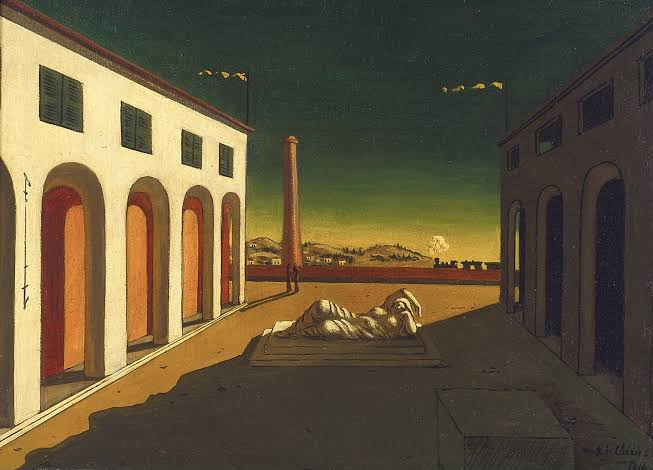
Giorgio de Chirico – Melancholia, 1916
The Metaphysical Art of Giorgio de Chirico
Giorgio de Chirico (1888–1978) was a pioneering Greek-born Italian painter and writer best known for founding the Scuola Metafisica (Metaphysical Art movement). His early paintings of deserted cityscapes, looming mannequins, and distorted perspectives profoundly influenced the Surrealist movement. In a controversial mid-career pivot, he rejected modernism in favor of classical techniques, spending his later decades exploring neo-Baroque styles and serially replicating his own early masterpieces.
Early Life and Philosophical Influences
Giorgio de Chirico was born on July 10, 1888, in Volos, Greece, to Italian parents. His father, Evaristo, was a railway engineer, a detail that heavily influenced the recurring motif of trains and smokestacks in de Chirico's later artwork.[1]
Following his father's death in 1905, de Chirico moved to Munich to study at the Academy of Fine Arts. The Bavarian capital served as a profound intellectual crucible. He became deeply absorbed in the Symbolist paintings of Arnold Böcklin and Max Klinger, as well as the philosophies of Arthur Schopenhauer and Friedrich Nietzsche.[2] Nietzsche’s assertion that a hidden, enigmatic reality exists beneath the surface of the everyday world became the foundational thesis for de Chirico’s entire artistic vision.[3]
"What is especially needed is great sensitivity: to look upon everything in the world as enigma…. To live in the world as in an immense museum of strange things." — Giorgio de Chirico[4]
Pittura Metafisica (Metaphysical Art)
Between 1910 and 1917, de Chirico developed the style that cemented his legacy: Pittura Metafisica. After brief stays in Florence and Turin—where he was captivated by the long shadows and stark, rectilinear architecture of the piazzas—he moved to Paris in 1911 and gained the support of the influential avant-garde poet Guillaume Apollinaire.[4:1]
In 1917, while recovering in a military hospital in Ferrara, Italy, de Chirico formally established the Scuola Metafisica alongside his brother Alberto Savinio, the former Futurist painter Carlo Carrà, and Filippo de Pisis.[5]
Key Characteristics
Metaphysical art is distinguished by a quiet, unsettling atmosphere of dreamlike menace. Core aesthetic elements include:
-
Distorted Perspective: The intentional collision of multiple vanishing points and tilted horizons to create spatial disorientation.[4:2]
-
Juxtaposition of Objects: Placing unrelated, mundane objects (gloves, artichokes, classical busts) next to one another to create a sense of mystery.[5:1]
-
Deserted Architecture: Empty arcades, towers, and classical plazas steeped in deep, melancholic shadows.
-
The Faceless Mannequin: Introduced around 1915, these blank, articulate figures replaced human subjects, serving as symbols of modern alienation and classical myth.[2:1]
Notable Works
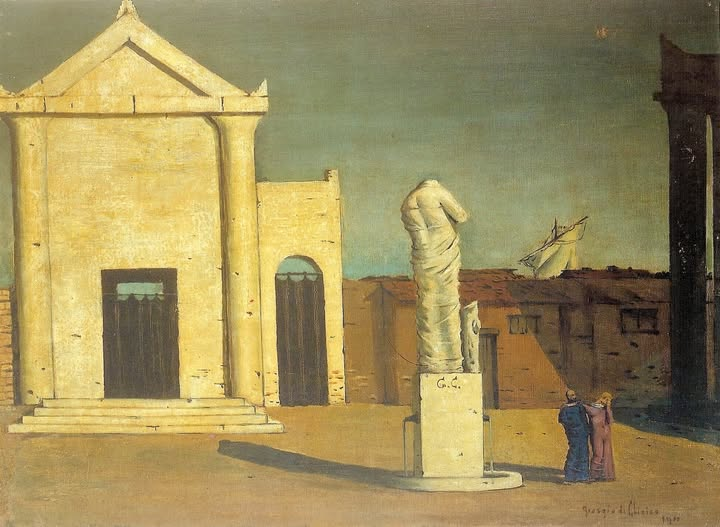
The Enigma of an Autumn Afternoon_ (1910)
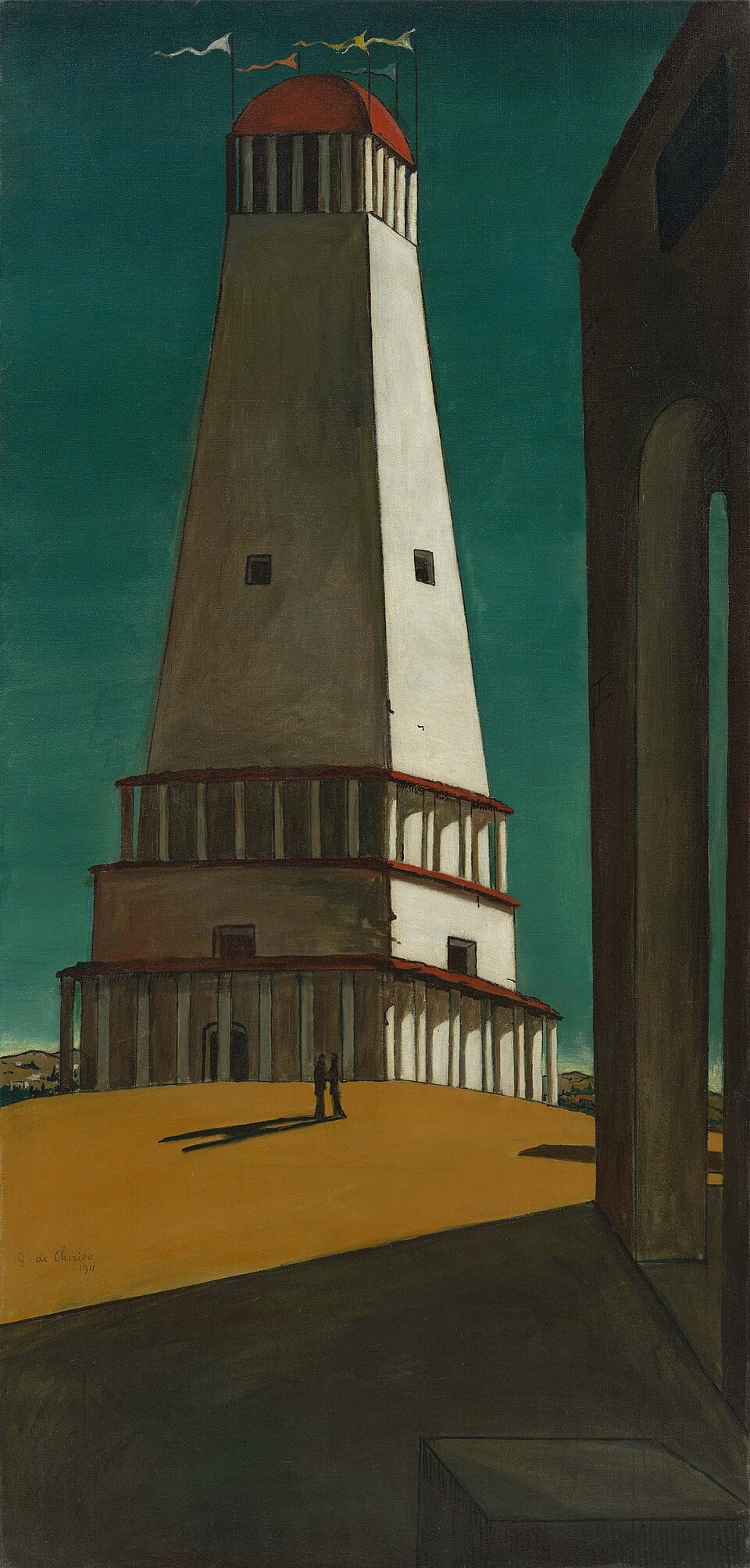
The Nostalgia of the Infinite_ (1911)
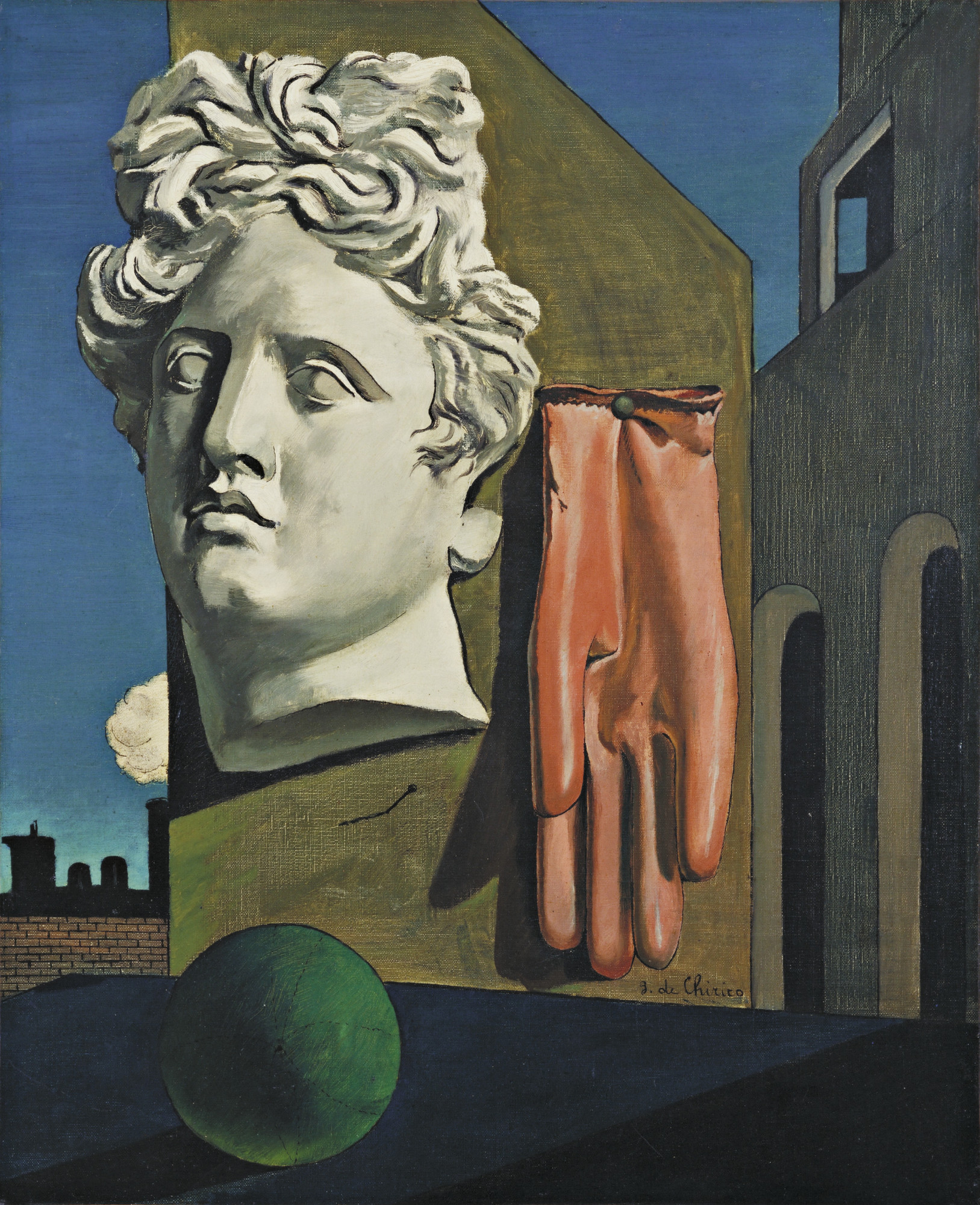
The Song of Love_ (1914)
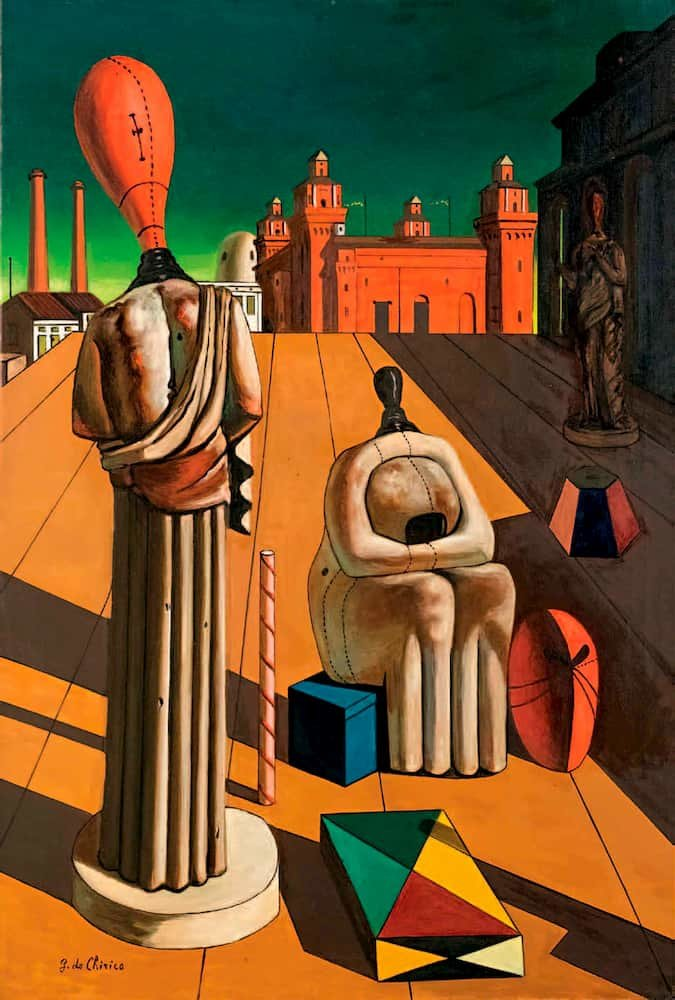
The Disquieting Muses_ (1916)
Impact on Surrealism
De Chirico's Metaphysical period served as a direct catalyst for the Surrealist movement in the 1920s. The French avant-garde saw in his claustrophobic dreamscapes the exact visual language needed to express the theories of the unconscious mind.
The founder of Surrealism, André Breton, considered de Chirico a vital "sentry" of the movement.[4:3] The impact on individual artists was profound; René Magritte claimed that seeing a reproduction of The Song of Love was one of the most moving moments of his life, stating, "my eyes saw thought for the first time."[6] Similarly, Yves Tanguy allegedly resolved to become a painter on the spot after seeing a de Chirico canvas in a gallery window from a passing bus.[6:1]
The "Return to Order" and Later Career
Despite his idolization by the Surrealists, de Chirico's artistic philosophy shifted dramatically after World War I. In 1919, he published an essay titled "The Return of Craftsmanship" in the journal Valori plastici, signaling his rejection of modernism and a pivot toward traditional methods and iconography.[6:2]
He embraced a neo-classical and neo-Baroque style, directly imitating Old Masters like Raphael, Titian, and Rubens. The Surrealists viewed this as a betrayal. The relationship deteriorated into bitter acrimony; in 1928, Breton and the Surrealists publicly mocked him by organizing a derogatory exhibition titled Here Lies Giorgio de Chirico.[2:2]
In his later decades, a resentful de Chirico deliberately blurred the lines of his own legacy by painting exact replicas of his early, highly coveted Metaphysical works, often backdating them to infuriate critics and undermine the art market.[7] This serial, almost mechanical self-appropriation was initially dismissed as reactionary "kitsch," but was later highly praised by Pop Artists like Andy Warhol.[3:1]
Literary Contributions: Hebdomeros
While primarily a visual artist, de Chirico also left a mark on literature. In 1929, he published his only full-length novel, Hebdomeros (written in French).[8]
The text is narrated in the third person and lacks a traditional plot, chapter divisions, or clear paragraph breaks. Instead, it follows the protagonist, Hebdomeros, through a series of fluid, dreamlike environments that perfectly mirror the aesthetic of de Chirico's Metaphysical paintings. Despite his bitter split with the Surrealists by the time of its publication, critics and literary historians universally classify Hebdomeros as a masterpiece of Surrealist fiction.[8:1]
Backlinks
-
Freud's The Uncanny (Das Unheimliche) — De Chirico's Pittura Metafisica — deserted arcades, distorted perspectives, faceless mannequins — is the visual art movement that most directly embodies the Freudian uncanny. His empty piazzas and looming shadows evoke the return of the repressed: the familiar rendered alien, the homely made unhomely, the city as a stage for the eerie recognition of something deeply known yet estranged.
-
The Failure of the Map-Art, the Uncanny, and the Divided Brain — De Chirico's Pittura Metafisica — with its distorted perspectives, deserted arcades, and faceless mannequins — is a visual embodiment of the left hemisphere's failure to categorize lived reality, generating the uncanny through deliberate cognitive dissonance.
-
Louis Sass - Phenomenological Psychopathology and the Self — De Chirico's Pittura Metafisica — deserted arcades, distorted perspectives, faceless mannequins — is the visual art movement that most directly embodies the "truth-taking stare" Sass describes: objects stripped of context, looming with eerie, unnamable significance.
-
Anthony Vidler-The Architectural Uncanny — De Chirico's empty piazzas, distorted perspectives, and looming shadows are the visual aesthetic that most directly embodies the architectural uncanny Vidler theorizes. His Pittura Metafisica — deserted arcades, faceless mannequins, claustrophobic urban spaces — is the uncanny metropolis rendered in paint.
References
Galleria dello Scudo / Giorgio de Chirico Biography / galleriadelloscudo.com ↩︎
Fondation Vincent Van Gogh / Giorgio De Chirico / fondation-vincentvangogh-arles.org ↩︎ ↩︎ ↩︎
Estorick Collection / Giorgio de Chirico / estorickcollection.com ↩︎ ↩︎
Museum of Modern Art (MoMA) / Giorgio de Chirico / moma.org ↩︎ ↩︎ ↩︎ ↩︎
Tate / Metaphysical Art / tate.org.uk ↩︎ ↩︎
Wikipedia / Giorgio de Chirico / wikipedia.org ↩︎ ↩︎ ↩︎
Phil Beard / Giorgio de Chirico, La fabrique des rêves / buttes-chaumont.blogspot.com ↩︎
Wikipedia / Hebdomeros / wikipedia.org ↩︎ ↩︎