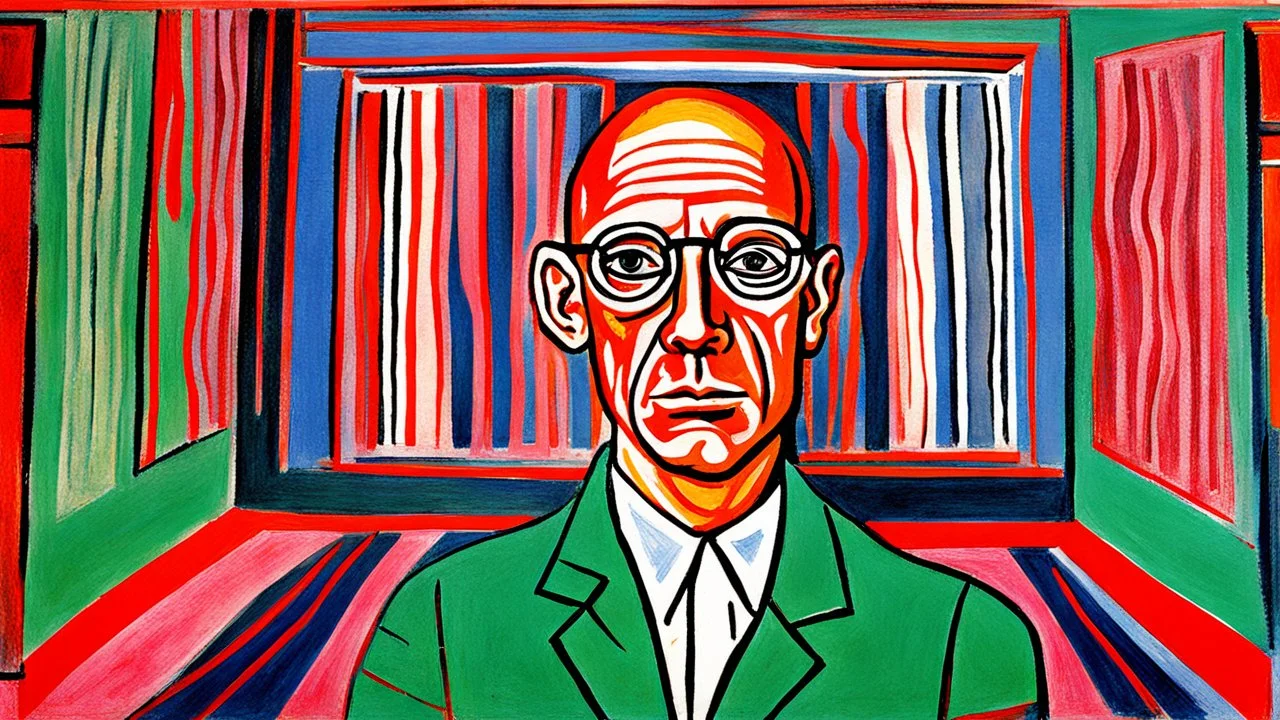
Michel Foucault
Building upon his foundational theories of power, knowledge, and discipline, Michel Foucault's later and more detailed scholarship shifted toward the intricate mechanisms of state power (governmentality) and the formation of the self (subjectivation). This deeper layer of his work explores how individuals internalize societal forces and how they might actively construct their own identities in resistance to them.
Intellectual Influences and Epistemological Roots
To understand Foucault's deeper methodologies, it is essential to trace the intellectual genealogy that informed his thought. He was profoundly shaped by the French tradition of the history of science, as well as German philosophy.[1]
-
Georges Canguilhem and Gaston Bachelard: Foucault inherited the concept of "epistemological breaks" from these French philosophers of science. They argued that scientific knowledge does not progress through a smooth, linear accumulation of facts, but through sudden, radical conceptual shifts. This directly inspired Foucault's "archaeological" method.[2]
-
Friedrich Nietzsche: Nietzsche's influence on Foucault cannot be overstated. From Nietzsche, Foucault adopted the "genealogical" method—the practice of exposing the messy, power-driven, and contingent origins of concepts (like morality or criminality) that society treats as natural or eternal truths.
-
Immanuel Kant: Foucault saw his own work as a continuation of Kant's critical project. Where Kant asked, "What are the limits of human understanding?", Foucault asked, "What are the historical conditions that make our current understanding of ourselves possible?"[3]
Deep Dive: Governmentality
In his lectures at the Collège de France in the late 1970s, Foucault expanded his focus from specific institutions (prisons, clinics) to the broader apparatus of the state. He introduced the concept of governmentality (a portmanteau of governmental and rationality).
Governmentality refers to the "art of government." It is the specific administrative rationality, techniques, and procedures by which populations are managed. It is not just about state politics, but encompasses the way people are taught to govern themselves and others.[4]
Foucault traced a historical shift from the Machiavellian model of the sovereign—whose primary goal was to retain territory and power—to a modern state focused on the welfare, wealth, and biological optimization of its population.
The Components of Governmentality
-
Pastoral Power: Foucault traced modern governance back to the Christian church's idea of a pastor caring for a flock. Modern states secularized this concept, presenting themselves as entities that ensure the salvation (health, wealth, and security) of their citizens.
-
Apparatus (Dispositif): The network of institutions, administrative measures, scientific statements, and philosophical propositions that work together to maintain power and manage populations.
-
Security Mechanisms: Unlike disciplinary power, which tries to control every movement of an individual body in an enclosed space (like a prison), security mechanisms operate on an open population. They deal with probabilities, statistics, and risk management (e.g., managing crime rates or disease outbreaks rather than preventing every single crime or illness).
Subjectivity and Technologies of the Self
In his final years, Foucault's focus shifted from how people are subjected to power by external forces to how people actively fashion themselves as subjects. This is explored in the later volumes of The History of Sexuality and his final lectures.
Assujettissement (Subjectivation)
Foucault used the French word assujettissement, which has a dual meaning: it means both being subject to someone else's control and being tied to one's own identity through a conscience or self-knowledge. Power creates "the subject" by giving the individual an identity to inhabit (e.g., "the homosexual," "the delinquent").[5]
"It is not power, but the subject, which is the general theme of my research." — Michel Foucault[6]
Technologies of the Self
To resist being entirely determined by disciplinary power, Foucault turned to Greco-Roman philosophy to study what he called "technologies of the self." These are intentional practices by which individuals operate on their own bodies, souls, thoughts, and conduct to transform themselves.
-
Care of the Self (Epimeleia Heautou): In antiquity, working on oneself (through meditation, journaling, diet, or physical training) was a prerequisite for being able to govern others.
-
An Aesthetics of Existence: Foucault suggested that in the modern era—where religious and legal moralities have lost their absolute authority—individuals must treat their own lives as a work of art, actively styling their existence rather than conforming to normalized identities.[5:1]
Interdisciplinary Legacy and Impact
Foucault's concepts provided the theoretical architecture for several major academic movements in the late 20th and early 21st centuries.
-
Queer Theory: Foucault's argument that "the homosexual" was a 19th-century discursive invention, rather than a timeless biological category, laid the groundwork for queer theorists like Judith Butler to argue that gender and sexuality are socially constructed and performative.[7]
-
Post-Colonial Studies: Edward Said explicitly utilized Foucault's concept of discourse to write Orientalism. Said argued that the "Orient" was a discursive construct created by Western powers to justify colonial domination.[8]
-
Critical Prison Studies: Foucault's Discipline and Punish remains the foundational text for scholars and activists examining the prison-industrial complex, mass incarceration, and the pervasive surveillance systems of the digital age.
Related Notes
The following notes in the vault engage with Foucault's ideas or resonate with his core themes:
-
Postscript on the Societies of Control — Gilles Deleuze's essay directly extends Foucault's concept of disciplinary societies into the contemporary paradigm of control societies, where enclosure is replaced by continuous modulation and digital tracking.
-
Dividual — Builds on the Foucault-to-Deleuze trajectory, exploring how the cohesive individual of disciplinary society dissolves into divisible data fragments under control society.
-
Information Networks and the Architecture of Social Order — Engages deeply with Foucault's power-knowledge critique, arguing that information systems reproduce social order rather than transmit neutral truth, and citing Foucault's definition of critique as "the art of not being governed quite so much."
-
Gestalt and Buddhism-Reality Construction — References Foucault's structuralist insight (the negative-filter analogy) to illustrate how the self is an emergent, operational Gestalt rather than a permanent, substantial core — resonating with his genealogical dismantling of fixed identities.
-
Motivation Theories Comparison — Applies Foucault's power-knowledge framework to organizational management, arguing that management information systems are tools of surveillance and discipline, not empowerment.
-
Continental Philosophy — Situates Foucault within the post-structuralist tradition alongside Derrida and Deleuze, summarizing his investigation of how institutions create systems of knowledge that exert control.
References
Gary Gutting / Michel Foucault / Stanford Encyclopedia of Philosophy ↩︎
Mary Tiles / Bachelard: Science and Objectivity / Cambridge University Press ↩︎
Michel Foucault / What is Enlightenment? / Foucault.info ↩︎
Michel Foucault / Security, Territory, Population: Lectures at the Collège de France 1977-1978 / Springer ↩︎
Michel Foucault / Technologies of the Self: A Seminar with Michel Foucault / University of Massachusetts Press ↩︎ ↩︎
Michel Foucault / The Subject and Power / [suspicious link removed] ↩︎
Judith Butler / Gender Trouble: Feminism and the Subversion of Identity / Routledge ↩︎
Edward Said / Orientalism / Penguin Random House ↩︎