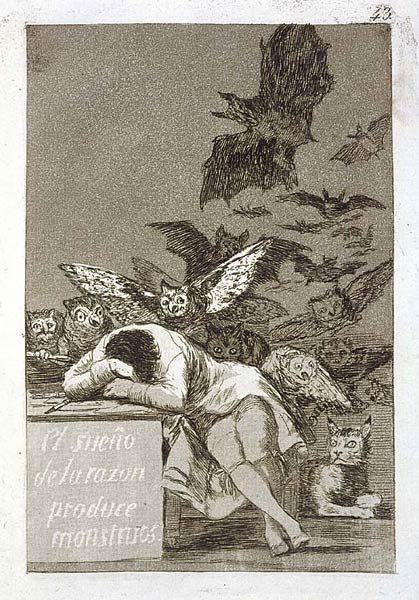
The Sleep of Reason Produces Monsters by Francisco Goya.
Francisco Goya's The Sleep of Reason Produces Monsters (El sueño de la razón produce monstruos) is a masterful 1799 etching and aquatint. Serving as plate 43 of his satirical portfolio Los Caprichos, the artwork warns against the dangers of abandoning rational thought while simultaneously arguing that imagination, when guided by reason, is the true mother of all arts.
Context and Los Caprichos
The Sleep of Reason Produces Monsters was created between 1797 and 1799 and published as part of an 80-print portfolio known as Los Caprichos (The Caprices or Follies).[1] During this era, Spain was grappling with the tension between deep-rooted, pre-Enlightenment traditions—such as intense clerical power, arranged marriages, and rampant superstition—and the rationalist ideals of the European Enlightenment.[2]
Goya utilized the series to launch a biting critique of contemporary Spanish society. Los Caprichos represented a significant departure from Goya’s previous work, which largely consisted of tapestry cartoons, church altars, and royal portraits.[2:1] Plate 43 was originally intended to be the title page of the portfolio, acting as Goya's personal manifesto for the series, before being placed near the middle of the published collection.[3]
Master of Aquatint
The print is a prime example of Goya's mastery of etching, aquatint, drypoint, and burin. Goya heavily utilized aquatint—a relatively new technique that etches a printing plate to reproduce tonal effects similar to watercolor washes.[1:1] This allowed him to create the dramatic, shadowy contrasts that heighten the macabre atmosphere of the piece.
Visual and Symbolic Analysis
The composition places the viewer in a dark, ominous psychological landscape:
-
The Sleeping Figure: A man—widely believed to be a self-portrait of Goya himself—slumps over a drawing table, his head buried in his arms.[2:2] His pen is cast aside, signaling that active, rational work has ceased.
-
The Inscription: Emblazoned on the front of his desk are the titular words: El sueño de la razon produce monstruos.[4]
-
The Owls: In Spanish folklore, owls were frequently associated with folly and demonic forces.[1:2] In the print, they swarm the sleeping man, with one mocking him by offering him a crayon-holder.
-
The Bats: Silhouettes of massive bats emerge from the deep background. They are traditional symbols of ignorance and the macabre.[1:3]
-
The Lynx: At the bottom right, a lynx sits quietly, wide-eyed and staring at the viewer. Known for its ability to see in the dark, the lynx symbolizes acute vision and alertness amidst the enveloping chaos.[2:3]
While the bats and owls attack the sleeping figure, some creatures, particularly the lynx and an owl perched on the chair, stare directly out of the composition. Goya forces the viewer to become an active participant, implying that these monsters of the mind threaten society as a whole.[2:4]
The Dual Meanings of Sueño
The artwork's enduring power comes from a purposeful ambiguity in its translation and its placement at the philosophical crossroads of Classicism (The Age of Reason) and Romanticism.[5]
In Spanish, the word sueño can mean both "sleep" (the absence of something) and "dream" (the unchecked excess of something).[4:1] This duality offers two distinct but complementary interpretations:
1. The Enlightenment Interpretation (The Sleep of Reason)
If sueño means "sleep," the phrase translates to "the sleep of reason produces monsters." This aligns with strict Enlightenment values. It suggests that when a society allows rational intelligence to slumber, irrationality, corruption, and the "monsters" of human nature take over.[1:4] Goya is critiquing the superstitious, illogical tendencies of 18th-century Spain, arguing that a lack of intellect and logic leads to societal decay.
2. The Romantic Interpretation (The Dream of Reason)
If sueño means "dream," the phrase warns that reason unchecked by reality or excessive reliance on pure logic can also breed monstrous outcomes.[4:2] This interpretation aligns perfectly with Goya's own caption written for the print:
"Imagination abandoned by reason produces impossible monsters; united with her, she is the mother of the arts and source of their wonders."[2:5]
In this light, Goya warns against being governed by reason alone. He insists that imagination and reason must unite to produce true art. Without imagination, logic is sterile; without reason, imagination descends into madness and horror.[5:1]
See Also
- Romantic Literature Themes Analysis — The Romantic rebellion against Enlightenment rationalism, the elevation of imagination over reason, and the Gothic as the shadow of the Age of Reason. Goya's print is a visual thesis statement for this entire literary movement.
- Northrop Frye's Fearful Symmetry - A Study of William Blake — Blake's mythological system, built on the same axis as Goya's print: the necessity of contraries (Reason and Energy), the critique of Urizenic rationality, and the wasteland of Ulro when imagination is abandoned.
- Goethe's Faust — Faust's "two souls" duality mirrors Goya's dual sueño; both works sit at the crossroads of Classicism and Romanticism, refusing to resolve the tension between reason and desire.
- Aldous Huxley's Heaven and Hell (1956) — Directly references Goya's Black Paintings and explores the same territory: the brain as a reducing valve, the autonomous monsters of the mind, and the "negative transfiguration" of visionary experience.
- The Matter With Things Analysis — Iain McGilchrist's neurophilosophical restatement of Goya's warning: left-hemisphere analytical dominance produces a mechanistic ontology that fragments reality and blinds us to the sacred.
- Information Networks and the Architecture of Social Order — A modern, sociological version of Goya's warning: when rational safeguards sleep, the monsters of tribalism, motivated reasoning, and social conformity take over.
- Confirmation Bias — The cognitive mechanism behind the monsters Goya depicts: motivated reasoning that distorts reality when rational safeguards fail.
- The Existential Paradox of Annie Hall's Opening Monologue — Alvy Singer's inability to stop reaching after reasons is the comic, modern version of what Goya warns against; the note engages with Keats's Negative Capability, the Romantic ideal of existing in uncertainty without irritable grasping after fact and reason.
References
Wikipedia / The Sleep of Reason Produces Monsters / Wikipedia ↩︎ ↩︎ ↩︎ ↩︎ ↩︎
UEN Digital Press / Francisco Goya, The Sleep of Reason Produces Monsters / Pressbooks ↩︎ ↩︎ ↩︎ ↩︎ ↩︎ ↩︎
The Metropolitan Museum of Art / Plate 43 from "Los Caprichos" / Met Museum ↩︎
Brooklyn Museum / The Sleep of Reason Produces Monsters / Brooklyn Museum ↩︎ ↩︎ ↩︎
The Fitzwilliam Museum / The Sleep of Reason Produces Monsters / Fitzwilliam ↩︎ ↩︎