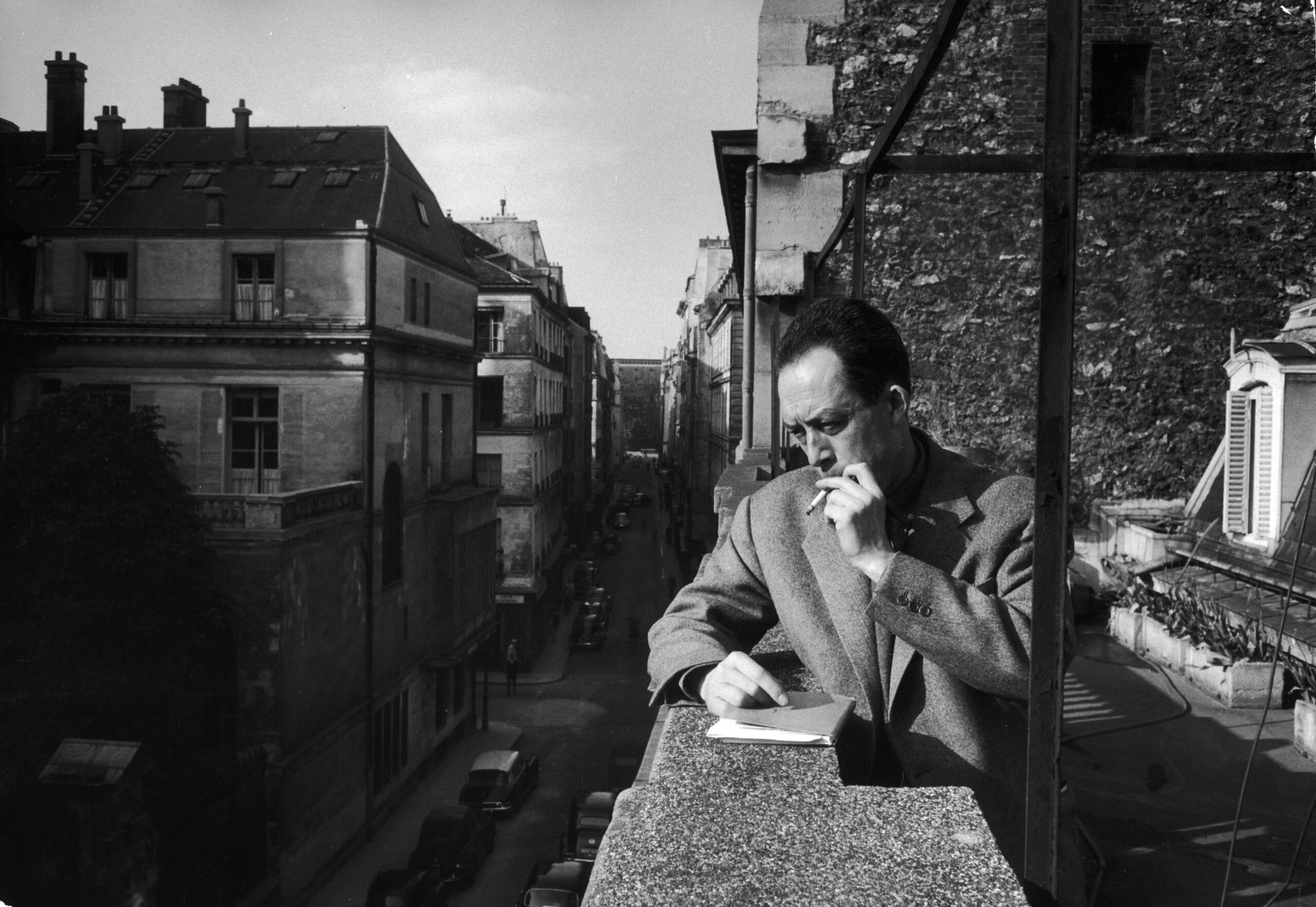
Albert Camus
Albert Camus (1913–1960) was a French-Algerian novelist, philosopher, dramatist, and political journalist who received the 1957 Nobel Prize in Literature. Best known for formulating the philosophy of Absurdism, Camus investigated the fundamental tension between humanity's search for inherent meaning and the silent, indifferent universe. His major works—including The Stranger, The Myth of Sisyphus, The Plague, and The Rebel—argued against both physical suicide and intellectual self-deception, advocating instead for conscious rebellion, personal freedom, and solidarity.
1. Biography and Formative Influences
Early Life in Algeria
Albert Camus was born on November 7, 1913, in Mondovi (now Dréan), French Algeria, to pied-noir (French-Algerian) parents. His father died in 1914 during World War I at the Battle of the Marne. Raised in near-poverty in a working-class neighborhood of Algiers by his mother, who was illiterate and partially deaf, Camus's early experiences deeply shaped his empathy for the working class and his acute sensitivity to physical hardship.[1]
Education, Illness, and Early Career
-
Tuberculosis Diagnosis: At age 17, Camus contracted tuberculosis, an illness that ended his athletic pursuits as a soccer goalkeeper and recurringly threatened his life. This early confrontation with mortality intensified his focus on the value of immediate human experience.
-
Philosophical Training: He studied philosophy at the University of Algiers under Jean Grenier, completing his thesis on Plotinus and Neo-Platonism in 1936.
-
Journalism: Camus began his career in Algiers as an investigative journalist for Alger-Républicain, where he documented the harsh living conditions of indigenous Kabyle Algerians under French colonial rule.
World War II and the Resistance
During World War II, Camus moved to occupied France. He joined the French Resistance and served as editor-in-chief of the clandestine newspaper Combat.[2] Writing under pseudonyms, he published anti-fascist editorials emphasizing moral integrity and post-war political renewal.
2. Core Philosophy: The Absurd and Revolt
While frequently grouped with Existentialists like Jean-Paul Sartre, Camus explicitly rejected the label, carving out a distinct philosophy known as Absurdism.
Camus defined the Absurd as the metaphysical friction generated by the confrontation between human consciousness—which constantly seeks purpose and order—and an indifferent, silent universe.
Human Demand for Meaning  <--->  Silent, Indifferent Universe
                               |
                        [ THE ABSURD ]
The Three Responses to the Absurd
In his 1942 essay The Myth of Sisyphus, Camus evaluated three potential responses to the Absurd:
-
Physical Suicide: Rejected by Camus as an evasion. Ending one's life eliminates the condition rather than confronting it.
-
Philosophical Suicide ("Leap of Faith"): Invoking religious dogma or abstract metaphysical systems (e.g., rationalism or religious existentialism) to invent artificial meaning. Camus considered this intellectual dishonesty.
-
Acceptance and Revolt (The Absurd Hero): Consciously living in full awareness of the Absurd while defiantly continuing to live, create, and experience life without false hope.
3. Key Literary Works and Intellectual Cycles
Camus structured his literary output into deliberate cycles comprising novels, philosophical essays, and plays.
Cycle 1: The Absurd
-
The Stranger (L'Étranger, 1942): A novel centered on Meursault, an emotionally detached clerk who shoots an Arab man on a sunlit beach. Meursault is ultimately condemned by society not merely for the killing, but for his refusal to conform to societal expectations or feign artificial emotions.
-
The Myth of Sisyphus (Le Mythe de Sisyphe, 1942): A philosophical essay exploring suicide and human purpose. Camus uses the Greek myth of Sisyphus—condemned to roll a boulder up a hill for eternity—as the ultimate metaphor for human existence. He famously concludes: "One must imagine Sisyphus happy."
Cycle 2: Revolt and Solidarity
-
The Plague (La Peste, 1947): Set in an epidemic-stricken Oran, Algeria, this novel serves as an allegory for resistance against totalitarianism and suffering. Characters like Dr. Bernard Rieux fight the disease through everyday duty and human decency rather than grand heroism.
-
The Rebel (L'Homme révolté, 1951): An extended essay analyzing political and historical rebellion. Camus argued that while moral revolt against tyranny is essential, political revolutions that justify mass violence in pursuit of utopian ideals inevitably betray human freedom.[1:1]
The publication of The Rebel in 1951 sparked a famous intellectual rupture between Camus and Jean-Paul Sartre. While Sartre defended Soviet communism as a necessary stage of revolutionary history, Camus vocally condemned Stalinism and political violence.
Cycle 3: Guilt and Judgment
- The Fall (La Chute, 1956): A dramatic monologue by Jean-Baptiste Clamence, a former Parisian lawyer turned self-proclaimed "judge-penitent" in Amsterdam. The novel examines modern hypocrisy, moral judgment, and personal guilt.
4. Political Stance and Ethics
Camus was a moral philosopher who consistently prioritized human rights over political doctrine.
| Dimension | Camus's Stance | Historical Context |
|---|---|---|
| Totalitarianism | Opposed both Nazism and Soviet Communism. | Rejected the idea that revolutionary ends justify oppressive means. |
| Capital Punishment | Strongly opposed. | Authored Reflections on the Guillotine (1957) condemning state-sanctioned execution. |
| Algerian War | Advocated civil truce and multi-ethnic coexistence. | Caught between his allegiance to French Algerians and justice for native Algerians. |
| Political Alignment | Libertarian Socialism / Anarcho-Syndicalism. | Favored grassroots worker organizations over state power. |
5. Nobel Prize and Death
-
Nobel Prize (1957): At age 44, Camus was awarded the Nobel Prize in Literature "for his important literary production, which with clear-sighted earnestness illuminates the problems of the human conscience in our time".[3]
-
Fatal Accident (1960): On January 4, 1960, Camus died in a car crash near Villeblevin, France, in a vehicle driven by his publisher Michel Gallimard.[4] Unused train tickets were discovered in his pocket, as he had originally intended to return to Paris by rail with his family.
"The struggle itself toward the heights is enough to fill a man's heart. One must imagine Sisyphus happy." — The Myth of Sisyphus (1942)
Resonant Notes
🔴 Strong Resonance
- Jean-Paul Sartre — Camus's philosophical counterpart and eventual rival. Both central figures of 20th-century French existentialism/absurdism, though Camus rejected the existentialist label. Their famous rupture over The Rebel (1951) — Sartre defending Soviet communism, Camus condemning Stalinist violence — represents a fundamental philosophical divide on the ethics of political revolt.
- Fyodor Dostoevsky — Dostoevsky's Underground Man is the quintessential literary precursor to Camus's absurd hero: a hyper-conscious individual who rejects rational systems and insists on irrational free will. Ivan Karamazov's rebellion against God's harmony directly anticipates Camus's analysis of metaphysical revolt.
- Franz Kafka — Kafka's opaque, irrational bureaucracies and alienated protagonists are the literary embodiment of the absurd condition Camus philosophically analyzed. Both writers depict individuals navigating systems that defy rational comprehension.
- Friedrich Nietzsche — Nietzsche's "Death of God" and the threat of nihilism provide the cultural diagnosis that Camus's Absurdism responds to. Where Nietzsche prescribes the Übermensch's self-creation of values, Camus prescribes conscious revolt without transcendence.
- Søren Kierkegaard — Kierkegaard's analysis of anxiety (angst), subjective truth, and the "leap of faith" are direct precursors to Camus's absurd. Camus explicitly rejected Kierkegaard's religious leap as "philosophical suicide," yet both thinkers start from the same existential diagnosis.
- Norman Mailer — Mailer's American Existentialism — his Manichean theology, critique of totalitarianism, and emphasis on radical freedom — places him in direct dialogue with Camus. Both see individual revolt as the authentic response to an administered, conformist society.
- Viktor Frankl — Frankl's Logotherapy (will to meaning) engages the same existential questions as Camus. Where Camus finds meaning in conscious revolt against meaninglessness, Frankl finds it in the freedom to choose one's attitude toward suffering.
- Woody Allen — Allen's secular existential anxiety, his characters' neurotic confrontation with mortality and meaninglessness, and his absurdist comedy are a late-20th-century cultural echo of Camus's absurd hero.
- Continental Philosophy — Camus is a central figure in the existentialist tradition within Continental philosophy. His Absurdism, alongside Sartre's existentialism and de Beauvoir's ethics, forms a core pillar of post-WWII French thought.
- Schopenhauerian Pessimism — Schopenhauer's diagnosis of endless striving and suffering as the fundamental condition of existence is the philosophical backdrop Camus responds to. Camus's absurd hero accepts this diagnosis but rejects Schopenhauer's prescription of ascetic denial.
References
David Sherman / Albert Camus (1913—1960) / Internet Encyclopedia of Philosophy ↩︎ ↩︎
Ronald Aronson / Albert Camus / Stanford Encyclopedia of Philosophy ↩︎
Nobel Prize Outreach / Albert Camus - Facts / NobelPrize.org ↩︎
Editors of Encyclopaedia Britannica / Albert Camus / Encyclopaedia Britannica ↩︎