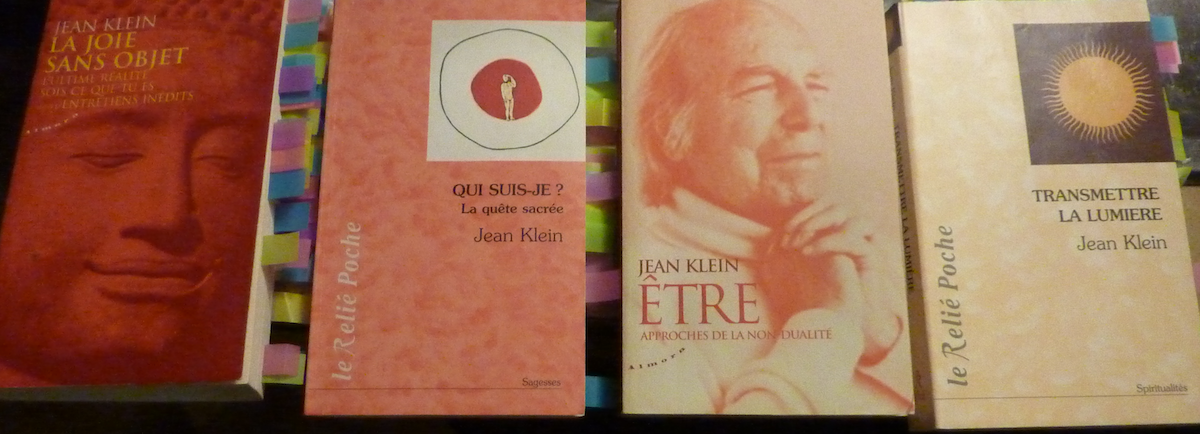
Jean Klein
Jean Klein (1912–1998) was a French mystic, musicologist, and spiritual teacher who introduced many Westerners to the nondual philosophies of Advaita Vedanta and Kashmir Shaivism. His teachings avoided rigid techniques and dogmas, focusing instead on a "Direct Approach" where one realizes their true nature as pure consciousness and spontaneous interior silence through choiceless awareness.
Core Philosophy: The Direct Approach
Jean Klein advocated for what he termed the "Direct Approach" to spiritual awakening.[1] He posited that individuals are fundamentally already the truth they are seeking, meaning there is inherently nothing to achieve or attain.[1:1] He taught that every step taken to try and "reach" this truth through effort, willpower, or volition paradoxically moves the seeker further away from it.[2] Instead of viewing spirituality as a path leading from one ignorant state to an enlightened one, Klein described it simply as an openness or a welcoming of our real nature, which he referred to as the "I Am."[1:2]
The Nature of the Self: Silence and Primal Awareness
According to Klein, humanity's true nature is found in a "spontaneous state of interior silence."[3] This silence is not merely a cessation of physical noise or a blank mind, but an eternal, causeless state of being that existed before the beginning of all things and serves as the home ground for all objects and experiences.[1:3] He frequently referred to this underlying reality as "primal awareness." Between two thoughts or between two sensory perceptions, this primal awareness exists untouched; it is the ultimate subject, the witness, and the Self.[1:4]
The Art of "Listening" and Choiceless Awareness
Rather than prescribing specific meditation techniques—which he felt manufactured artificial states of mind—Klein taught the art of "listening."[4] He viewed the human mind and senses as inherently grasping, and suggested that by dropping this grasp, the entire body becomes a spontaneous, open organ of sensitivity.[1:5]
Klein heavily encouraged unmotivated, choiceless alertness. This means observing thoughts, emotions, and physical sensations without judgment, condemnation, or the underlying desire to change them.[2:1]
In this state of "choiceless living," situations are allowed to unfold naturally. Klein believed that true internal stillness—a stillness free of a "controller" trying to be still—acts as the only real mechanism for unwinding deep biological and psychological conditioning.[2:2]
The Role of the Spiritual Teacher
Klein held a unique, highly egalitarian perspective on the guru-disciple dynamic. He believed a true teacher does not hold an image of themselves as an elevated teacher, nor do they view the student as a deficient pupil.[4:1] In the absence of these projected identities and power dynamics, there is a "coming together" or an overarching oneness where genuine transmission occurs.[4:2] The teacher's primary function in this relationship is simply to bring clarity to the student's mind until it naturally stops grasping and rests in silence.[4:3]
Critique of Progressive Paths and "Evolution"
A distinct element of Klein’s philosophy was his firm rejection of progressive spiritual paths and the concept of psychological evolution.[1:6]
-
The Trap of Duality: He argued that progressive techniques simply keep the practitioner locked within a subject-object duality.[4:4]
-
The Subtle Object: In this framework, even highly refined "blank states" of mind achieved through deep, concentrated meditation become subtle objects of attachment for the ego.[4:5]
-
Sudden Discernment: He rejected the modern notion of spiritual evolution, defining true liberation as a product of sudden discernment and immediate realization, rather than the culmination of gradual, linear improvement.[1:7]
Backlinks
- Ralph Waldo Emerson — Klein's "Direct Approach" — the teaching that individuals are already the truth they seek — resonates with Emerson's conviction that spiritual truth is found through inner intuition rather than external authority or institutional mediation. Emerson's Oversoul and Klein's "primal awareness" both describe a transcendent reality accessible through direct, unmediated experience.
Resonant Notes
The following vault notes resonate with Jean Klein's teachings on nonduality, Advaita Vedanta, choiceless awareness, and the Direct Approach:
- Meher Baba — Both are Western-facing nondual mystics who rejected progressive spiritual paths in favor of direct realization. Meher Baba's Advaita-leaning assertion that "God alone exists" and his anti-dogmatic instruction to find the core truth within one's own tradition parallel Klein's Direct Approach and his rejection of technique-based spirituality.
- The Core Instruction - Turning the Gaze Inward — This note's exploration of "looking for the looker" — the inversion of attention that collapses the subject-object divide — is precisely what Klein taught as the art of "listening" and choiceless awareness. The instruction is strictly experiential, not analytical, mirroring Klein's rejection of technique and his insistence on immediate, non-conceptual discernment.
- Constructs of the Mind-Unmasking Consciousness in East and West — The Madhyamaka analysis of awareness (Prajñā) describes a "background field of luminous, unified, and immutable awareness that exists prior to conceptual thought" — which maps directly onto Klein's "primal awareness" and "spontaneous state of interior silence." The argument that the cessation of dualistic grasping unveils pure awareness echoes Klein's teaching that true stillness is not a blank mind but the home ground of all experience.
- William James — James's distinction between "Sciousness" (pure, immediate consciousness-without-self) and "Con-sciousness" (reflective egoic awareness) is a near-perfect parallel to Klein's teaching. James described sciousness as a state of raw witnessing where the subject-object divide has not yet materialized — exactly what Klein called "primal awareness" between two thoughts.
- Perennial Philosophy — This note explicitly covers Advaita Vedanta — the very tradition Klein synthesized and taught. The core nondual realization that Atman and Brahman are identical, and that liberation occurs upon the experiential realization of Tat Tvam Asi ("That Thou Art"), is the philosophical backbone of Klein's entire teaching.
References
Eric Baret on Vedantic & Tantric elements in Jean Klein's teaching
This discussion by a former student offers valuable context on how Jean Klein synthesized the traditions of Advaita Vedanta and Kashmiri Tantra.