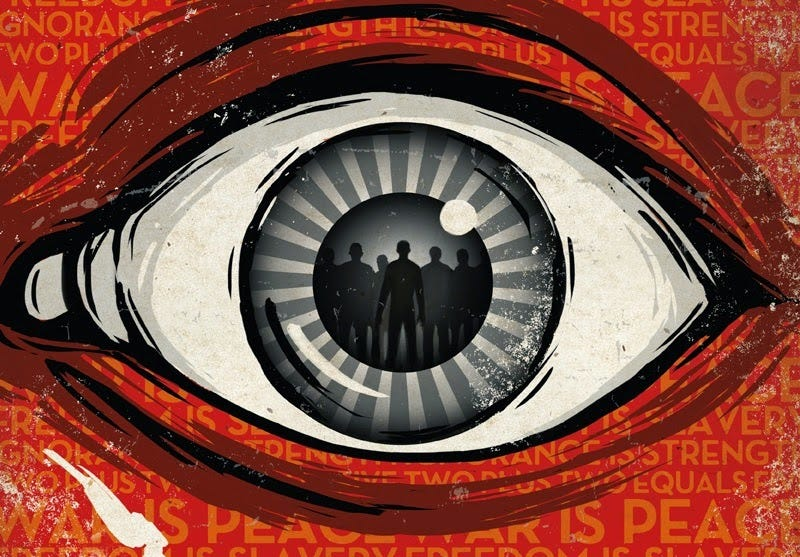
George Orwell: Life, Works, and Political Thought
George Orwell (pen name of Eric Arthur Blair, 1903–1950) was an English novelist, essayist, journalist, and social critic whose work is defined by lucid prose, opposition to totalitarianism, and commitment to democratic socialism.[1] Best known for his allegorical novella Animal Farm (1945) and dystopian novel Nineteen Eighty-Four (1949), Orwell’s writings remain crucial reference points for discussions on state surveillance, political propaganda, and language manipulation.
Biographical Overview
Early Life & Colonial Experience (1903–1927)
-
Birth & Heritage: Born Eric Arthur Blair on June 25, 1903, in Motihari, Bengal, British India, to a civil servant in the Opium Department of the Indian Civil Service.[1:1]
-
Education: Raised primarily in England, Blair attended St Cyprian's preparatory school and earned a King's Scholarship to Eton College (1917–1921), where he was tutored briefly by Aldous Huxley.
-
Burmese Imperial Police: Choosing service over university, Blair joined the Indian Imperial Police in Burma in 1922. His five years enforcing colonial rule bred a deep aversion to imperialism, inspiring early essays such as "A Hanging" (1931) and "Shooting an Elephant" (1936).
Tramping, Poverty, and Pseudonym (1928–1936)
-
Living Among the Outcasts: Resigning from the Imperial Police in 1927, Blair pursued writing full-time and deliberately experienced poverty, working as a dishwasher in Paris and living alongside vagrants in London.
-
Adoption of Pen Name: In 1933, he published Down and Out in Paris and London under the pseudonym George Orwell—combining the patron saint of England (St. George) with the River Orwell in Suffolk.
-
Social Investigation: Commissioned by publisher Victor Gollancz in 1936 to study living conditions in northern England, Orwell authored The Road to Wigan Pier (1937), a key work of social journalism highlighting working-class poverty and outlining his early alignment with democratic socialism.[2]
Spanish Civil War & World War II (1936–1945)
-
Fighting Fascism in Spain: In December 1936, Orwell traveled to Spain to cover the civil war and enlisted in the militia of the POUM (Partido Obrero de Unificación Marxista), an anti-Stalinist socialist group.
-
Injury & Anti-Stalinism: After being shot in the neck by a sniper on the Aragon front in May 1937, he witnessed Stalinist factions purge political rivals in Barcelona. This experience, documented in Homage to Catalonia (1938), shaped his lifelong hostility toward Soviet Communism.
-
Wartime Journalism: Declared medically unfit for military duty during World War II, Orwell produced cultural and political broadcasts for the BBC Eastern Service (1941–1943) and served as literary editor for the left-wing journal Tribune.
Final Years & Death (1945–1950)
-
International Success: Orwell achieved world renown with Animal Farm (1945) and Nineteen Eighty-Four (1949).
-
Isle of Jura: Suffering from severe tuberculosis, Orwell moved to a remote farmhouse on Jura, Scotland, in 1946 to complete Nineteen Eighty-Four under harsh physical conditions.
-
Passing: Orwell succumbed to tuberculosis in a London hospital on January 21, 1950, at the age of 46.[1:2]
Major Works & Analysis
| Title | Year | Format | Core Theme / Topic |
|---|---|---|---|
| Down and Out in Paris and London | 1933 | Memoir | Economic marginalization, class prejudice, and extreme poverty |
| The Road to Wigan Pier | 1937 | Reportage / Essay | Industrial working-class conditions and critique of British socialism |
| Homage to Catalonia | 1938 | Historical Memoir | Personal account of the Spanish Civil War and totalitarian factionalism |
| Animal Farm | 1945 | Allegorical Novella | Satire of the Russian Revolution, Stalinism, and corrupted ideals |
| Nineteen Eighty-Four | 1949 | Dystopian Novel | Totalitarianism, mass surveillance, historical negationism, and language control |
In this influential essay, Orwell argued that sloppy language is both a cause and a symptom of political degeneration.[3] He contended that political rhetoric is often designed "to make lies sound truthful and murder respectable," prescribing strict rules for clarity, conciseness, and intellectual honesty in prose.
Core Themes & Philosophical Standpoint
Anti-Totalitarianism & Democratic Socialism
Orwell maintained a clear distinction between Soviet communism and democratic socialism, viewing democratic rights as fundamental to any just economic system. In his 1946 essay "Why I Write", he clarified his political objective:[3:1]
"Every line of serious work that I have written since 1936 has been written, directly or indirectly, against totalitarianism and for democratic socialism, as I understand it."
Language, Propaganda, and Control
Central to Orwell's analysis of power is how centralized regimes manipulate thought by altering words and history:
-
Doublethink: The psychological ability to hold two contradictory beliefs in one's mind simultaneously, and accept both of them.
-
Newspeak: A state-engineered language constructed to eliminate subversion by restricting vocabulary until dissenting thought becomes impossible.
-
Historical Negationism: The continuous rewriting of past records to align with current party doctrine ("Who controls the past controls the future: who controls the present controls the past").
Cultural Legacy & Modern Terminology
The term Orwellian is frequently misapplied to general policy disputes. Accurately used, it refers specifically to official deception, pervasive surveillance, historical revisionism, and the corruption of language to suppress independent thought.
Concepts introduced by Orwell remain widespread in contemporary sociopolitical discussion:
-
Big Brother: Symbol of total, invasive state supervision.
-
Thoughtcrime: Ideological nonconformity or internal dissent against an authority.
-
Memory Hole: Systemic deletion or destruction of awkward historical facts.
Resonant Notes
The following notes in the vault resonate with Orwell's themes of totalitarianism, surveillance, propaganda, language control, and democratic socialism:
-
Norman Mailer — Mailer's critique of "soft totalitarianism" and technological standardization directly extends Orwell's warnings about the dehumanizing forces of modern institutions. Both writers saw corporate capitalism and state bureaucracy as threats to individual existential freedom.
-
Yuval Noah Harari — Harari's analysis of information networks, the tension between truth and order, and the structural differences between democratic and totalitarian regimes echoes Orwell's framework of Newspeak and historical negationism. Harari's "Dictator's Dilemma" updates Orwell's surveillance concerns for the AI age.
-
Franz Kafka — Kafka's depiction of absurd, impenetrable bureaucracies and faceless authorities prefigures Orwell's totalitarian state. Both writers explore how institutional structures trap individuals in procedural nightmares where guilt is assumed and appeal is impossible.
-
Fyodor Dostoevsky — Dostoevsky's prophetic vision in Demons of ideological totalitarianism — where intellectual skepticism morphs into violent nihilism and mass enslavement — directly anticipates Orwell's warnings about the corruption of revolutionary ideals into authoritarian control.
-
Don DeLillo Major Themes Analysis — DeLillo's exploration of paranoia, conspiracy, media saturation, and the "soft totalitarianism" of consumer capitalism updates Orwell's Nineteen Eighty-Four for the postmodern age. The terrorist as narrative-maker parallels Orwell's insight about who controls the story controls reality.
-
Analytical Review - Nexus and the Evolution of Information Networks — This analysis of Harari's Nexus directly engages the democracy vs. totalitarianism binary, examining how centralized vs. decentralized information networks determine political freedom — a core Orwellian concern.
-
Information Networks and the Architecture of Social Order — The "Dictator's Dilemma" and the erosion of democratic institutions through AI surveillance and algorithmic polarization are direct extensions of Orwell's warnings about totalitarian information control.
-
Innis (1951) - The Bias of Communication — Innis's concept of "Monopolies of Knowledge" — where elites control communication technologies to consolidate power — parallels Orwell's insight that controlling language and information is the foundation of political control.
-
The Attention Economy — The erosion of cognitive autonomy through algorithmic manipulation and "dark patterns" represents a 21st-century instantiation of Orwell's concern about the manipulation of thought through environmental control.
-
Lipman-Blumen - The Allure of Toxic Leaders — This psychological analysis of why followers willingly submit to authoritarian leaders provides the micro-foundations for the mass compliance Orwell depicted in Nineteen Eighty-Four.
-
Jean-Paul Sartre — Sartre's concept of littérature engagée — the writer's moral obligation to political engagement — mirrors Orwell's own conviction that every line of serious work must be written against totalitarianism and for democratic socialism.
-
The Digital Mirror and the Lotus — This note's analysis of algorithmic systems as a "Cosmic Jailer" trapping users in feedback loops of desire updates Orwell's surveillance state for the age of AI-driven attention capture and digital manipulation.
Backlinks
- Portmanteau (also known as a lexical blend or blend word) — Orwell's pen name is itself a portmanteau: St. George + River Orwell.
References
D.J. Taylor / Biography of George Orwell / The Orwell Foundation ↩︎ ↩︎ ↩︎
Special Collections / Orwell-Gollancz Papers / UCL Library Services ↩︎
George Orwell / Index of Essays and Articles / Orwell.ru Library ↩︎ ↩︎