Ludwig Wittgenstein: The Architecture of Language and Reality
Ludwig Wittgenstein (1889–1951) was an Austro-British philosopher who fundamentally redirected 20th-century philosophy through his rigorous inquiries into logic, semantics, and the limits of human expression. He is unique in intellectual history for producing two radically opposing, yet globally foundational, philosophical masterpieces: the early Tractatus Logico-Philosophicus and the posthumous Philosophical Investigations.[1]
1. Biography and Intellectual Trajectory
Born in Vienna in 1889 into one of Europe's wealthiest and most culturally vibrant industrial families, Wittgenstein was exposed early to art, music, and rigorous discipline.[1:1] Initially pursuing engineering and aeronautics—which led him to study propeller design and pure mathematics—his intellectual passions shifted toward logic.[2] This shift brought him to the University of Cambridge in 1912 to study under Bertrand Russell, who quickly recognized Wittgenstein's fierce intellect and eccentric brilliance.[2:1]
Upon his first term at Cambridge, Wittgenstein famously asked Bertrand Russell whether he was a "complete idiot," explaining that if he was, he would become a pilot, and if not, a philosopher. Russell instructed him to write a paper over break; upon reading it, Russell immediately confirmed he should stay in philosophy.[2:2]
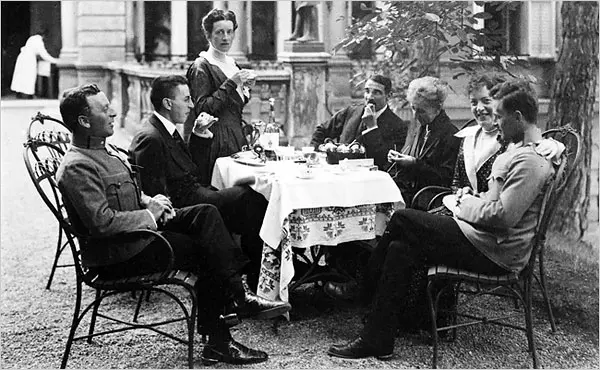
During World War I, Wittgenstein volunteered for the Austro-Hungarian Army, serving on the front lines while continuously writing his revolutionary thoughts on logic and representation.[3] Believing he had completely solved all fundamental problems of philosophy in his resulting manuscript, he abandoned academic philosophy for nearly a decade—working as an elementary school gardener and teacher in rural Austrian villages, and later assisting his sister in designing a modernist mansion in Vienna.[2:3] He returned to Cambridge in 1929, where his thinking underwent a radical metamorphosis, shifting away from rigid formal logic toward the pragmatic, context-driven fluidity of everyday human language.[1:2]
2. The Early Philosophy: The Tractatus Logico-Philosophicus
Published in 1921 (and the only book Wittgenstein published during his lifetime), the Tractatus is a short, aphoristic masterwork written in numbered decimal propositions.[1:3]
The Picture Theory of Meaning
The core thesis of the Tractatus asserts that language is a logical picture of reality.[3:1]
-
Propositions as Pictures: Just as a scale model represents a physical traffic accident, a meaningful sentence shares the same logical multiplicity and structure (the logical form) as the state of affairs it depicts in the world.[3:2]
-
The Limits of Language: "The limits of my language mean the limits of my world."[4] For Wittgenstein, anything that can be thought can be said clearly; what cannot be said clearly belongs to the realm of the unsayable.[1:4]
"Whereof one cannot speak, thereof one must be silent."
— Ludwig Wittgenstein, Tractatus Logico-Philosophicus
The Fate of Metaphysics
Under this strict criterion of meaningfulness, traditional philosophical problems—ethics, aesthetics, religion, and metaphysics—are not difficult empirical puzzles; they are literally nonsense (unsinnig), because they attempt to speak about things that lie outside the logical boundaries of the empirical world.[3:3] They are valuable pointers to the mystical, but they cannot be stated as factual propositions.
3. The Later Philosophy: Philosophical Investigations
Upon returning to philosophy, Wittgenstein systematically dismantled his earlier work. Published posthumously in 1953, Philosophical Investigations replaces the rigid picture theory with a fluid, anthropological approach to language.[1:5]
Language-Games
Wittgenstein argued that language is not a singular, monolithic mirror of reality, but a heterogeneous collection of practices he termed language-games (Sprachspiele).[2:4]
-
Meaning is derived not from correlation with objects, but from use within a specific social context.[2:5]
-
Words function like tools in a tool chest: a hammer, a chisel, and a glue gun have entirely different functions; asking for the "essence" of a tool is a category error.[3:4]
Family Resemblance
To combat the essentialist trap—the assumption that every general term (like "game," "art," or "number") must share a single, defining common denominator—Wittgenstein introduced the concept of family resemblance (Familienähnlichkeit).[5]
-
Concepts are bound together by overlapping, criss-crossing networks of similarities, much like the physical traits (eyes, nose, gait) shared by members of a human family.[5:1]
-
There is no single core essence common to all games (e.g., chess vs. tennis vs. solitaire), yet the category remains entirely coherent and functional.[5:2]
Wittgenstein's analysis of rules demonstrated that following a rule is a communal, practical embedded activity—leading to his famous private language argument, which proved that a language referring exclusively to an individual's private inner sensations is logically impossible because there is no external standard to distinguish correct usage from incorrect usage.[1:6]
4. Philosophical Legacy and Impact
Wittgenstein's influence spans multiple intellectual domains:
-
Analytic Philosophy & Ordinary Language: Inspired philosophers at Oxford and Cambridge (such as Gilbert Ryle and J.L. Austin) to examine how everyday language actually operates rather than constructing abstract artificial systems.[2:6]
-
Philosophy of Mind & Cognitive Science: His later work anticipated modern discussions on embodied cognition, rule-following, and AI behaviorism by emphasizing that meaning and intentionality are rooted in active, social practices rather than isolated internal mental representations.[1:7]
-
Cultural Impact: His austere personal integrity, intense rejection of academic pretension, and poetic aphorisms have made him an enduring cultural icon in literature, architecture, and contemporary art.[3:5]
Deep Conceptual Resonance
Wittgenstein's philosophy lands with the force of a diagnosis rather than a doctrine. Reading the Tractatus, you feel the exhilaration of a perfectly sealed logical system — only to have the later Wittgenstein dismantle it from the inside, showing that the very desire for such a system is the disease philosophy needs to cure. That arc from the crystalline purity of the picture theory to the messy, anthropological richness of language-games mirrors something true about intellectual growth itself: the movement from wanting final answers to learning to see how language actually works in the rough ground of everyday life.
The private language argument, in particular, has a way of reconfiguring how you think about mind, self, and meaning. The idea that even your inner life is not a private theater to which only you have access, but is constituted by shared practices and public criteria — that there is no such thing as a purely personal language — is both unsettling and liberating. It means that meaning, understanding, and even selfhood are not possessions you hold in isolation but achievements of participation in a community. Wittgenstein's quiet insistence that philosophy leaves everything as it is, that its job is not to discover new truths but to untangle the confusions we create when language goes on holiday — this is a humility that feels more radical than any system-building.
Related Notes
- Language as a Tool — Heidegger vs Wittgenstein — A comparative analysis of Wittgenstein's and Heidegger's radically opposed views on language: the tool metaphor vs. the "house of being."
The following notes in the vault engage with Wittgenstein's ideas or resonate with his core themes:
The following notes in the vault engage with Wittgenstein's ideas or resonate with his core themes:
Conceptual Parallels
-
Dimensional Containers and the Fabric of Reality-The Divergence of Space, Void, and Emptiness — Opens with a rigorous investigation into how the English language conflates the concepts of "space," "void," and "emptiness," creating profound epistemological confusion. The entire project — tracing how linguistic categories constrain and distort our understanding of reality — is a direct application of Wittgenstein's method of exposing how language leads us into philosophical dead ends. The note's etymological analysis of how "Western linguistic frameworks developed to prioritize the substantive over the relational" echoes Wittgenstein's diagnosis of how grammar bewitches us into treating abstract nouns as if they named discrete objects.
-
Epistemology of Preference-Avijjā, Māna, and the Emptiness of Aesthetic Taste in Buddhist Philosophy — Argues that aesthetic disputes are fundamentally confused because taste is a private, unobservable experience — "a clash of completely isolated, solipsistic universes." This directly parallels Wittgenstein's private language argument: if meaning requires a public criterion of correctness, then arguing about taste as if there were objective facts of the matter is a category error. The note's therapeutic dissolution of the pseudo-problem of aesthetic disagreement is deeply Wittgensteinian in structure.
-
The Digital Mirror and the Lotus — The section "Reflecting Meaning vs. Finding Meaning" argues that meaning is not something an AI generates or discovers, but something that arises from human use and context. The conclusion that "the meaning is generated exclusively on the human side of the interaction" is a direct application of Wittgenstein's meaning-as-use: symbols do not carry meaning intrinsically; meaning is constituted by how they are used within a specific form of life.
-
Information Networks and the Architecture of Social Order — Argues that "meaning must be generated and sustained socially" because information transmission is "structurally agnostic to truth." This resonates with Wittgenstein's later philosophy, where meaning is not an inherent property of propositions but emerges from shared practices, conventions, and forms of life within a community.
-
Comparative Analysis of Cetanā and Free Will in Buddhist Philosophy — Deploys the concept of "category mistake" (a tool from the ordinary language philosophy tradition Wittgenstein inspired) to dissolve the apparent conflict between determinism and free will, arguing that the problem arises from illegitimately mixing two distinct vocabularies — a deeply Wittgensteinian therapeutic move that treats a philosophical puzzle as an artifact of conceptual confusion rather than a genuine metaphysical problem.
-
Animism and the Vault — A Map of Resonances — References Ryle's critique of Cartesian dualism as a "category mistake" (the "ghost in the machine"), a concept rooted in the ordinary language approach that Wittgenstein pioneered, which treats philosophical problems as artifacts of faulty conceptual framing rather than genuine mysteries.
References
Stanford Encyclopedia of Philosophy / Ludwig Wittgenstein / Stanford Encyclopedia of Philosophy ↩︎ ↩︎ ↩︎ ↩︎ ↩︎ ↩︎ ↩︎ ↩︎
Internet Encyclopedia of Philosophy / Ludwig Wittgenstein / Internet Encyclopedia of Philosophy ↩︎ ↩︎ ↩︎ ↩︎ ↩︎ ↩︎ ↩︎
Austin Tannenbaum / An Introduction to Ludwig Wittgenstein / Medium ↩︎ ↩︎ ↩︎ ↩︎ ↩︎ ↩︎
Study.com / Ludwig Wittgenstein: Biography, Philosophy & Quotes / Study.com ↩︎