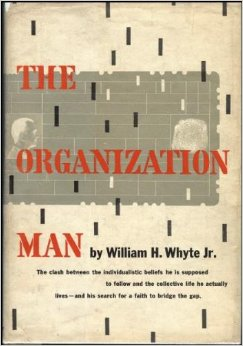
William H. Whyte's _The Organization Man
Published in 1956, William H. Whyte's The Organization Man is a foundational sociological text that analyzes the shift in American culture from the individualistic "Protestant Ethic" to a collectivist "Social Ethic." It critiques how postwar corporate life, suburbanization, and education systems demanded conformity, groupthink, and extreme loyalty at the expense of individual creativity and self-reliance.
The Shift from Individualism to Conformity
William H. Whyte, an editor at Fortune magazine, spent years studying corporate America and observing a fundamental transformation in the mid-20th-century American character.[1] Historically, the United States was built on the Protestant Ethic—the belief that hard work, thrift, and individual competitive struggle were the primary engines of success and salvation.[2]
However, the postwar economic boom and the rise of massive corporate bureaucracies gave birth to what Whyte termed the Social Ethic.[3] This new ethos argued that the group, rather than the individual, was the ultimate source of creativity and productivity.[4] According to Whyte, the modern white-collar worker was expected to spiritually and physically subordinate themselves to the benevolent organization, essentially taking "vows of organization life."[5]
Key Concepts and Sociological Observations
The Three Pillars of the "Social Ethic"
Whyte argued that the Social Ethic was built upon three core tenets:
-
The belief in the group as the source of creativity: The assumption that consensus, committee work, and team synergy produce better results than a solitary thinker.[6]
-
The belief in "belongingness" as the ultimate human need: The idea that individuals find their psychological security and primary purpose by fitting smoothly into a larger group.[7]
-
The belief in the application of science to achieve belongingness: The use of management theory, organizational psychology, and behavioral testing to ensure harmonious "cultural fit."[8]
The Cult of Personality Testing
One of the most famous critiques in the book surrounds the corporate reliance on personality tests to screen employees. Whyte argued these tests did not measure true competence, leadership, or brilliance; rather, they measured conformity and a lack of eccentricity. To highlight the absurdity of this practice, Whyte included advice on how to cheat on personality tests, encouraging ambitious workers to provide the most bland, well-adjusted, and middle-of-the-road answers possible to beat the system.
Suburbia: The Organization Family
The book extends its analysis beyond the boardroom and into the home. Whyte conducted extensive fieldwork in the newly built, planned suburb of Park Forest, Illinois.[9] He viewed these communities as the domestic wing of the corporation:
-
Transience and Rootlessness: Organization men were highly mobile, frequently relocating their families whenever the company demanded.[10] Suburbs became environments where forming fast, superficial bonds and "fitting in" quickly were paramount to survival.
-
Hyper-Socialization: Suburban life was intensely communal. Whyte noted that non-participation in neighborhood gatherings or failure to conform to consumption habits (like buying the same consumer goods as neighbors) was viewed as almost antisocial.[11]
Education and the Decline of the Humanities
Whyte noted that universities were increasingly acting as vocational training grounds for the corporation. The focus shifted away from fundamental academic inquiry and the humanities, leaning heavily toward business administration and "social adjustment."[12] The primary goal of higher education, he warned, was no longer to produce independent, critical thinkers, but rather highly employable, frictionless team players.
Modern Relevance
While the 1950s era of "lifetime employment" at a single company has largely ended, Whyte’s observations on corporate psychology remain strikingly prescient today.
Though the "new economy" of the 1990s and the rise of Silicon Valley startups temporarily celebrated the "rebel entrepreneur," the fundamental pressures of the Social Ethic persist in modern knowledge work.[13] Today's corporate emphasis on "company culture," team synergy, open-plan offices, and behavioral screening during hiring are direct descendants of Whyte’s Organization Man.[14] Furthermore, the pressure to integrate work and life—where the modern professional is expected to be deeply, emotionally tied to the corporate mission—echoes Whyte's original warning: the organization does not just want the worker's labor; it wants their soul. The entrepreneurial alternative—starting with your own means and building ventures through personal agency rather than corporate belonging—is formalized in Saras Sarasvathy’s effectuation theory (see Effectuation).
Backlinks
- From Walls of Wood to Walls of Glass - Northrop Frye's Geography of Isolation — Whyte's analysis of the Social Ethic — the pressure to conform, belong, and subordinate individuality to the group — is the American corporate equivalent of Frye's garrison mentality. Where Frye's garrison was built against a hostile wilderness, Whyte's Organization Man builds walls against social non-conformity. Frye's condominium mentality — "neither social nor creative" — is the late-20th-century endpoint of Whyte's hyper-socialized suburbia.
Resonant Notes
The following notes in this vault resonate with Whyte's analysis of the Social Ethic, corporate conformity, and the tension between individual autonomy and organizational control:
-
Durkheimian Sociology and Reified Gestalt — Provides the sociological scaffolding for Whyte's Social Ethic. Durkheim's concept of collective effervescence — where group rituals generate a heightened emotional state that makes the abstract group feel tangible and sacred — explains exactly how the Organization Man's "belongingness" becomes coercive. Social facts as reified gestalts mirror Whyte's observation that the corporation presents itself as an objective reality demanding loyalty.
-
Reconciling the Control Paradigm — Directly engages with Whyte's core concern: the tension between control and autonomy in organizations. Examines how flat, self-managed structures require extensive personality vetting for "cultural alignment" — a modern echo of Whyte's critique of personality testing as a conformity-screening tool. Employees conditioned by decades of top-down compliance who struggle with autonomy are direct descendants of Whyte's Organization Man.
-
Consumer Behavior and the Architecture of Influence — Features the Asch Conformity Paradigm, the psychological mechanism underlying Whyte's Social Ethic. Asch's experiments demonstrated that individuals will override direct sensory evidence to align with a group — the same dynamic Whyte observed in corporate committee culture and suburban hyper-socialization.
-
Motivation Theories Comparison — William Ouchi's Theory Z — emphasizing lifetime employment, collective decision-making, and strong corporate culture built on trust and belonging — reads as a management textbook codification of Whyte's Social Ethic. The contrast between Theory Z and more individualistic management theories mirrors Whyte's central tension between the Protestant Ethic and the Social Ethic.
-
Digital Infrastructure of Delusion — The critique of "The Culture Monster" — the destructive force in organizations that discourages initiative, implements counterproductive rules, and creates environments where employees fear speaking honestly — is a modern diagnosis of the same pathology Whyte identified in the 1950s corporation. The advocacy for B Corps and the Mindful Business Charter represents the contemporary response to Whyte's warning: that the organization wants the worker's soul, not just their labor.
References
William H. Whyte / The Organization Man / Yale Law School Open Scholarship ↩︎
William H. Whyte / The Organization Man / Yale Law School Open Scholarship ↩︎
Nikki Springer / William Whyte's The Organization Man / Blackwell's ↩︎
Paul Millerd / The Organization Man by William Whyte: Where Corporate Loyalty & the Career Ladder Began / pmillerd.com ↩︎
Paul Millerd / The Organization Man by William Whyte: Where Corporate Loyalty & the Career Ladder Began / pmillerd.com ↩︎
Nikki Springer / William Whyte's The Organization Man / Blackwell's ↩︎
Paul Millerd / The Organization Man by William Whyte: Where Corporate Loyalty & the Career Ladder Began / pmillerd.com ↩︎
Paul Millerd / The Organization Man by William Whyte: Where Corporate Loyalty & the Career Ladder Began / pmillerd.com ↩︎
Google Books / The Organization Man (Publisher Synopsis) / Google Books ↩︎
Paul Millerd / The Organization Man by William Whyte: Where Corporate Loyalty & the Career Ladder Began / pmillerd.com ↩︎
Paul Millerd / The Organization Man by William Whyte: Where Corporate Loyalty & the Career Ladder Began / pmillerd.com ↩︎
Paul Millerd / The Organization Man by William Whyte: Where Corporate Loyalty & the Career Ladder Began / pmillerd.com ↩︎
National Book Foundation / The Organization Man / National Book Foundation ↩︎
Google Books / The Organization Man (Publisher Synopsis) / Google Books ↩︎