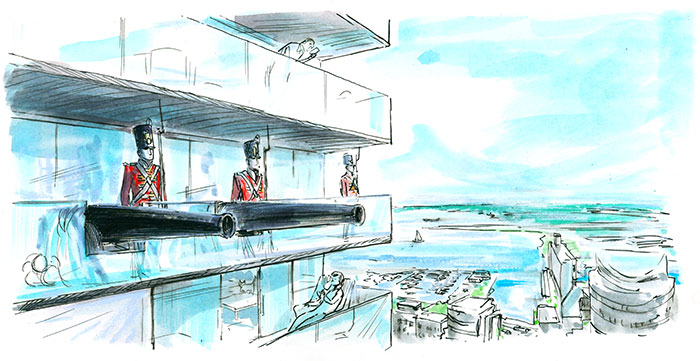
From Walls of Wood to Walls of Glass: Northrop Frye’s Geography of Isolation
Literary critic Northrop Frye introduced the concept of the garrison mentality in his 1965 "Conclusion" to the Literary History of Canada to explain the psychological foundations of early Canadian literature.[1] Confronted by an immense and hostile wilderness, early European settlers built tightly regulated communities that prioritized law, order, and collective survival over individual expression.[1:1]
In his later writings during the late 1980s, Frye updated his thesis to diagnose modern urban life through the condominium mentality.[1:2] While the historic garrison was "social but not creative," Frye argued that the modern condominium is "neither social nor creative"—an introverted mode of high-rise living where architecture isolates individuals from both natural geography and civic community.[1:3] [2]
The Garrison Mentality: Historical Foundations
The garrison mentality thesis emerged as the foundational model of Canadian thematic criticism, later collected in Frye’s The Bush Garden: Essays on the Canadian Imagination (1971).[1:4] Frye posited that early settlers experienced profound psychological vulnerability when faced with Canada's vast, unmapped, and formidable physical setting.[1:5]
"Small and isolated communities surrounded with a physical or psychological 'frontier,' separated from one another and from their American and British cultural sources... are compelled to feel a great respect for the law and order that holds them together." [1:6]
Core Characteristics of the Garrison Mindset
-
Fear of the Unclaimed Landscape: Nature was perceived not as a romantic frontier to be conquered, but as an indifferent or terrifying force capable of erasing human identity.[1:7] [3]
-
Hyper-Conformity and Social Cohesion: Survival required absolute commitment to institutional authority, social hierarchy, and shared moral codes.[1:8]
-
Suppression of Individualism: Personal ambition or artistic non-conformity was viewed with suspicion, as deviation threatened the survival of the group.[1:9]
-
Didactic and Defensive Art: Literature produced within a garrison prioritized moral instruction, self-preservation, and utility over creative experimentation.[1:10]
Evolution and Major Literary Interpretations
Frye’s thesis served as the bedrock for subsequent Canadian literary theorists who expanded on the psychological relationship between Canadian authors and their landscape.[3:1]
Margaret Atwood and Survival (1972)
In her seminal work Survival: A Thematic Guide to Canadian Literature, author Margaret Atwood expanded on Frye's garrison thesis by arguing that the central organizing motif of Canadian literature is survival.[3:2] Atwood contended that where American literature centers on the frontier and British literature on the island, Canadian literature centers on surviving against an overwhelming environment, framing nature as an unsympathetic antagonist.[3:3]
D.G. Jones and Butterfly on Rock (1970)
Poet and critic D.G. Jones further developed the metaphor through a theological and psychological lens.[3:4] Jones argued that early Canadian literature was trapped in a defensive fear of the natural world, but suggested that modern Canadian writers were tasking themselves with breaking down the garrison walls to achieve a more harmonious relationship with nature.[3:5]
-
Susanna Moodie (Roughing It in the Bush, 1852): Depicts the hardships, terror, and moral anxieties faced by a British settler navigating the alien Upper Canadian wilderness.[3:6]
-
E.J. Pratt (Brébeuf and His Brethren, 1940 & Towards the Last Spike, 1952): Illustrates heroic human effort and collective discipline pitted against harsh terrain.[4]
-
Margaret Atwood (Surfacing, 1972): Explores themes of psychological breakdown and the fear of disappearing into the "bush."[3:7]
Comparative Context: Garrison vs. Frontier Myth
| Cultural Metric | Canadian Garrison Mentality | American Frontier Myth |
|---|---|---|
| Primary Relation to Nature | Fear, retreat, and self-defense against an indifferent landscape.[1:11] | Conquest, expansion, and individual mastery over nature.[1:12] |
| Social Structure | Prioritizes collective law, order, and institutional stability.[1:13] | Prioritizes rugged individualism, self-reliance, and liberty.[1:14] |
| Psychological Stance | Introspective, defensive, and risk-averse.[3:8] | Outward-looking, adventurous, and expansive.[1:15] |
| Artistic Expression | Historically didactic, cautious, and community-focused.[1:16] | Heroic, mythic, and individualistic.[1:17] |
The Condominium Mentality of Modern Life
By the late 1980s, Frye recognized that Canada had transformed from a rural settler nation into a hyper-urbanized society.[1:18] Addressing this shift, he observed that the old garrison had mutated into a new urban phenomenon: the condominium mentality.[1:19] [2:1]
-
Garrison Mentality: Social but not creative. It forced intense mutual dependence and strict social cohesion out of physical necessity, though its defensive rigidity suppressed creative risk.[1:20] [2:2]
-
Condominium Mentality: Neither social nor creative. It packs populations into dense, vertical spaces while completely atomizing them socially, creating an environment defined by passive consumption and psychological detachment.[1:21] [2:3]
1. The Architecture of Enclosure and Public Retreat
The high-rise condominium functions as an updated, privatized fort.[2:4] Where the log garrison was built to keep out the harsh wilderness, the condominium tower is engineered to wall off the chaotic public realm—urban decay, traffic, pollution, and social inequality.[2:5] Equipped with keyfobs, private concierges, underground parking, and private gyms, the condominium allows residents to live and work without ever interacting with the municipal street.[2:6]
2. Proximity Without Community
The condominium mentality represents a psychological paradox: hyper-density combined with radical detachment.[2:7]
-
Physical Proximity: Hundreds of individuals live separated only by thin concrete slabs.[2:8]
-
Social Isolation: Residents consciously maintain anonymity, avoiding eye contact in elevators and shunning civic or neighborly obligations.[2:9]
-
Pseudo-Public Spaces: Shared building amenities (lounges, rooftop terraces) offer the appearance of community while serving merely as private real estate features.[2:10]
3. Financialization of Space and Real Estate Transience
In the condominium paradigm, the living unit ceases to be a home rooted in a geographical community; instead, it is experienced primarily as a financial asset or investment vehicle.[2:11] This financialization fosters transience, as occupants view their living situation as temporary leverage for capital gain rather than a place to cultivate long-term civic ties or local culture.[2:12]
4. Psychological Impact on Modern Art and Literature
Frye argued that the condominium mentality creates a hostile environment for art.[1:22] Lacking both the organic connection to nature and the shared struggles of community, artists operating inside the condominium mindset struggle against a culture of sterile comfort.[1:23] Modern literature shifts its focus from surviving the elements to surviving urban claustrophobia, alienation, and social invisibility.[3:9] [2:13]
Scholarly Critiques and Modern Revaluations
While the garrison mentality dominated Canadian literary study for decades, it faced significant criticism beginning in the late 20th century.[3:10]
-
Eurocentric Bias and Indigenous Erasure: Critics point out that the thesis centers exclusively on Anglo-European settler anxieties.[1:24] Indigenous nations did not view the land as a hostile wilderness, but as a home and provider. The garrison thesis effectively erased Indigenous presence and ecological wisdom.[1:25]
-
Environmental Determinism: Literary scholar Eli Mandel argued that writers "invent" the landscape through text rather than having their minds passively determined by physical geography.[3:11]
-
Reductionism: Critics like Frank Davey in Surviving the Paraphrase argued that thematic criticism like Frye's ignored formal aesthetics, regional diversity, and urban realities in favor of a monolithic national myth.[3:12]
Resonant Notes
🔴 Strong Resonance
-
Northrop Frye — The source of the garrison and condominium mentalities analyzed in this note. Frye's broader framework of archetypal criticism, the four mythoi, and the "verbal universe" provides the theoretical scaffolding for understanding how Canadian literature evolved from defensive settler narratives to modern urban alienation.
-
English-language Canadian Literature (English CanLit) — Frye's garrison mentality is directly cited as a foundational critical framework in this vault's CanLit note. The note traces how early Canadian literature was governed by a defensive psychological stance against a hostile wilderness — the exact thesis Frye formulated. Margaret Atwood's Survival (1972) built directly on Frye's garrison thesis.
-
Group of Seven (also known as the Algonquin School) — The visual arts counterpart to Frye's literary analysis. The Group of Seven's project of forging a distinctly Canadian visual identity by rejecting European academic traditions parallels Frye's analysis of Canadian cultural identity in The Bush Garden. Both represent attempts to articulate an indigenous cultural language against colonial inheritance.
🟡 Structural & Thematic Resonance
-
William H. Whyte's The Organization Man — Whyte's analysis of the Social Ethic — the pressure to conform, belong, and subordinate individuality to the group — is the American corporate equivalent of Frye's garrison mentality. Where Frye's garrison was built against a hostile wilderness, Whyte's Organization Man builds walls against social non-conformity. Frye's condominium mentality — "neither social nor creative" — is the late-20th-century endpoint of Whyte's hyper-socialized suburbia.
-
Norman Mailer — Mailer's critique of "plastic" totalitarianism — technological progress, corporate capitalism, and modern urban planning as forces of soft totalitarianism — resonates with Frye's condominium mentality. Mailer's Hipster vs. Square dichotomy mirrors Frye's garrison (social but not creative) vs. condominium (neither social nor creative) — both diagnose the same crisis of authentic human connection in an administered society.
-
Travis Bickle — Travis Bickle's urban alienation in Taxi Driver is the cinematic embodiment of Frye's condominium mentality. Travis lives in radical isolation within hyper-density — surrounded by millions yet utterly disconnected. His psychological breakdown is what happens when the condominium mentality's "proximity without community" reaches its pathological extreme.
-
The Matter With Things Analysis — McGilchrist's diagnosis of left-hemisphere dominance — the "unmaking of the world" through abstraction, control, and fragmentation — provides a neuroscientific framework for Frye's condominium mentality. The shift from garrison (embodied, communal, defensive) to condominium (abstracted, isolated, detached) mirrors McGilchrist's account of how modern civilization has become alienated from holistic, embodied experience.
🟢 Peripheral & Thematic Resonance
-
Durkheimian Sociology — Durkheim's mechanical vs. organic solidarity provides a sociological framework for Frye's historical shift. The garrison mentality corresponds to mechanical solidarity (strong collective consciousness, shared beliefs, repressive law), while the condominium mentality represents a pathological form of organic solidarity — high interdependence without genuine community, anomie as architecture.
-
Dethroning the Ego - Rael’s Journey Through the Subterranean Mythos of Genesis — Rael's "Concrete Jungle" — a cynical, consumerist, hyper-masculine New York City where he protects himself with a tough exterior — is the condominium mentality rendered as rock opera. The protagonist's journey through the subway (the subterranean) is an attempt to break through the walls of glass back to authentic connection.
-
Media Theory Concept Research — McLuhan's "global village" and the "discarnate man" — individuals communicating without physical bodies, leading to aggression and lack of empathy — is the condominium mentality extended into digital space. Frye's architecture of isolation has been virtualized: we now live in condominiums of the mind, walled off by screens and algorithms.
-
Freud's The Uncanny (Das Unheimliche) — Freud's foundational essay on the uncanny — the return of the repressed, the unhomely, the familiar rendered alien — provides the psychoanalytic framework that underlies both Frye's condominium mentality and Vidler's architectural uncanny. The shift from garrison to condominium is a sociological instantiation of the Freudian unheimlich: the home that no longer shelters.
-
Anthony Vidler-The Architectural Uncanny — Vidler's analysis of the modern metropolis as a labyrinthine space that induces alienation, paranoia, and agoraphobia is the architectural-theoretical counterpart to Frye's condominium mentality. Both diagnose how modern architecture produces estrangement rather than shelter — Frye through literary criticism, Vidler through architectural history and psychoanalysis.
References
The Canadian Encyclopedia / Garrison Mentality / The Canadian Encyclopedia ↩︎ ↩︎ ↩︎ ↩︎ ↩︎ ↩︎ ↩︎ ↩︎ ↩︎ ↩︎ ↩︎ ↩︎ ↩︎ ↩︎ ↩︎ ↩︎ ↩︎ ↩︎ ↩︎ ↩︎ ↩︎ ↩︎ ↩︎ ↩︎ ↩︎ ↩︎
Ouno Design / Of Culture and Condos - Northrop Frye on condo mentality/garrison mentality / Ouno Design ↩︎ ↩︎ ↩︎ ↩︎ ↩︎ ↩︎ ↩︎ ↩︎ ↩︎ ↩︎ ↩︎ ↩︎ ↩︎ ↩︎
Wikipedia / Garrison mentality / Wikipedia ↩︎ ↩︎ ↩︎ ↩︎ ↩︎ ↩︎ ↩︎ ↩︎ ↩︎ ↩︎ ↩︎ ↩︎ ↩︎
E.J. Pratt Library / Case 10: Frye and Canadian Literature / Victoria University Library ↩︎