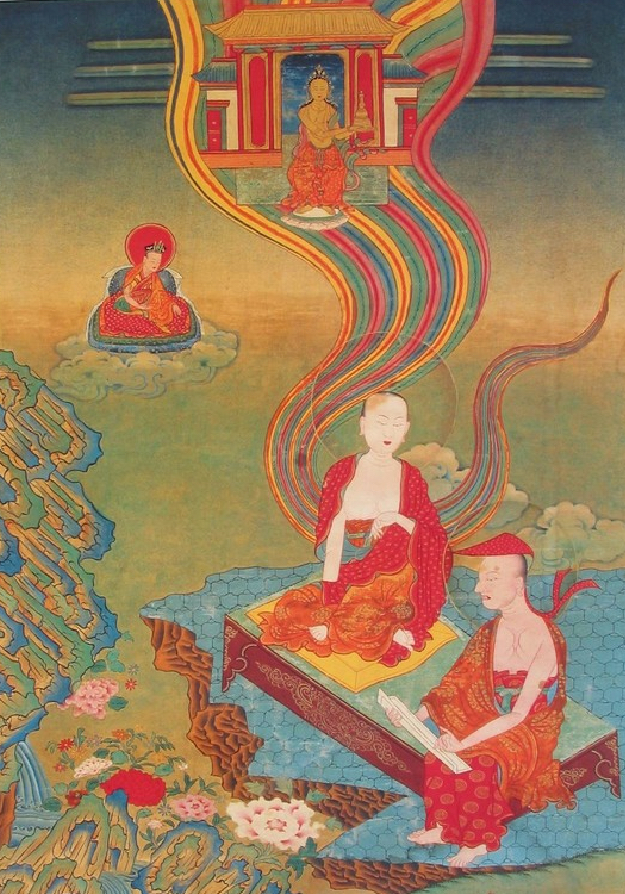
Asaṅga and Vasubandhu
> [!summary] > > Asaṅga and Vasubandhu were 4th-to-5th-century CE half-brothers from the region of Gandhāra who profoundly shaped the trajectory of Mahāyāna Buddhism. Together, they founded and systematized the Yogācāra ("Yoga Practice") school, also known as the _Vijñānavāda_ (Consciousness Way) or _Cittamātra_ (Mind-Only) tradition. Their synthesis of rigorous meditative practice, epistemology, and psychology remains foundational to Buddhist philosophy across Tibet, East Asia, and the modern world. > >
Historical Context and Biographies
Born in Puruṣapura (modern-day Peshawar, Pakistan) in the ancient region of Gandhāra, Asaṅga and Vasubandhu lived during a golden age of Indian philosophical debate.[1] Monastic centers were flourishing, and thinkers were actively systemizing the vast, often disparate teachings of the Buddha. The primary biographical sources for their lives come from the 6th-century translator Paramārtha and the 7th-century Chinese pilgrim Xuanzang, though these accounts blend historical fact with legendary elements.[2]
Asaṅga (fl. 4th–5th Century CE)
Asaṅga began his monastic career in the Sarvāstivāda or Mahīśāsaka tradition of early Buddhism, but soon became dissatisfied with its philosophical frameworks.[3]
According to traditional accounts, this dissatisfaction led him to undertake intensive meditation retreats. After twelve years of arduous practice, he is said to have experienced a transformative vision of the Bodhisattva Maitreya.[4] Tradition holds that Maitreya transported Asaṅga to the Tuṣita Heaven to impart a series of profound texts. Regardless of the historicity of this mystical encounter, Asaṅga emerged from his retreat to author foundational treatises that shifted Buddhist focus toward the mechanisms of mind and perception.
Vasubandhu (fl. 4th–5th Century CE)
Vasubandhu, Asaṅga's younger half-brother, was initially a staunch defender of the Sarvāstivāda and Sautrāntika schools. Before his conversion to Mahāyāna Buddhism, he authored the Abhidharmakośa (Treasury of Abhidharma) and its auto-commentary.[1:1] This text remains one of the most masterful, encyclopedic summaries of early Buddhist metaphysics and is still a mandatory subject of study in Tibetan monastic universities today.[2:1]
Historical accounts state that Asaṅga, feigning a severe illness, summoned Vasubandhu. During this visit, Asaṅga exposed his brother to Mahāyāna doctrines.[3:1] The intellectual rigor Vasubandhu previously applied to early Buddhist scholasticism was subsequently redirected toward defending and refining his brother's Yogācāra philosophy.
Vasubandhu's transition from a skeptic of Mahāyāna to its greatest systematizer was a pivotal moment in Buddhist history. His analytical genius translated Asaṅga's visionary and meditative experiences into a precise, logically unassailable philosophical framework.
Core Philosophies: The Yogācāra School
The Yogācāra school emerged as one of the two major philosophical currents of Mahāyāna Buddhism, alongside Nāgārjuna's Madhyamaka (Middle Way). While Madhyamaka deconstructed reality to reveal its "emptiness" (śūnyatā), Yogācāra sought to explain how delusion arises in the mind and how liberation is practically achieved.[2:2]
The brothers developed several groundbreaking psychological frameworks:
-
Vijñapti-mātra (Appearance-Only): Often translated as "Consciousness-Only," this doctrine asserts that all phenomena we experience are strictly constructions of the mind. Yogācāra argues that subject-object duality is a cognitive illusion; we do not experience an external reality, but rather the mind's own representations.[5]
-
Ālaya-vijñāna (Storehouse Consciousness): To explain how karma and memory function without a permanent soul (ātman), the brothers conceptualized a foundational layer of consciousness. This "storehouse" accumulates karmic "seeds" (bīja) from past actions, which later ripen to produce our perceived reality.[4:1]
-
Trisvabhāva (The Three Natures): A framework explaining the nature of reality in three tiers:
-
Imaginary Nature (Parikalpita): The false, dualistic way ordinary beings perceive the world (subject vs. object).
-
Dependent Nature (Paratantra): The causal flow of phenomena, arising dependently based on karmic seeds.
-
Perfected Nature (Pariniṣpanna): The realization of reality exactly as it is, free from the imaginary duality.
-
Modern scholars frequently compare Vasubandhu's arguments in the Viṃśatikā to Western philosophical concepts like Immanuel Kant's transcendental idealism and phenomenology, noting his sophisticated deconstruction of atomic theory and external objects.[5:1]
Major Works and Literary Contributions
The literary output of the two brothers established the curriculum for Mahāyāna Buddhist psychology.
Asaṅga's Foundational Texts
Asaṅga's works are highly practice-oriented, detailing the stages of the bodhisattva path and the cultivation of meditative insight.
-
Yogācārabhūmi-śāstra (Treatise on the Stages of Yoga Practice): A massive encyclopedia mapping the stages of spiritual development.
-
Mahāyānasaṃgraha (Summary of the Great Vehicle): A core text outlining the rationale of the Ālaya-vijñāna and the path of the bodhisattva.[3:2]
-
Abhidharmasamuccaya (Compendium of Abhidharma): A Mahāyāna restructuring of psychological phenomenology.
Vasubandhu's Analytical Treatises
Vasubandhu is celebrated for his concise, philosophically dense poetic verses.
-
Abhidharmakośakārikā: His pre-Mahāyāna masterpiece on traditional metaphysics.[1:2]
-
Viṃśatikā (Twenty Verses): A polemical text systematically refuting the existence of external, mind-independent objects.[5:2]
-
Triṃśikā (Thirty Verses): A concise, elegant summary of the entire Yogācāra system, including the transformation of the eight consciousnesses into enlightened wisdom.
Legacy and Influence
The intellectual partnership between Asaṅga and Vasubandhu forever altered the Buddhist landscape. Following their deaths, Yogācāra split into various specialized branches led by later commentators like Dignāga, Dharmapāla, and Sthiramati.[3:3]
Their texts were transmitted to China by translators like Paramārtha and Xuanzang, birthing the Chinese Faxiang (East Asian Yogācāra) school, which subsequently spread to Korea and Japan (Hosso school). In the Tibetan tradition, their treatises on Abhidharma, logic, and epistemology remain core pillars of monastic education. Because of their profound contributions at the ancient university of Nalanda, both brothers are venerated among the "Seventeen Nalanda Masters."[5:3]
References
Internet Encyclopedia of Philosophy / Vasubandhu / IEP ↩︎ ↩︎ ↩︎
Fabrizio Musacchio / Asaṅga and Vasubandhu: Synthesizing Yogācāra thought / Fabrizio Musacchio ↩︎ ↩︎ ↩︎
EBSCO Research Starters / Asanga and Mahāyāna Buddhism / EBSCO ↩︎ ↩︎ ↩︎ ↩︎
Spiritual Gurus AI / Asanga: Yogacara Buddhist Teachings / Spiritual Gurus AI ↩︎ ↩︎