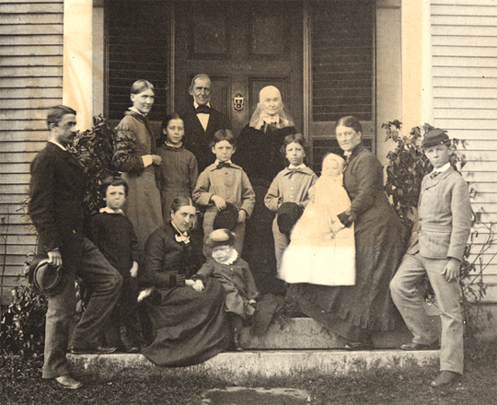
Ralph Waldo Emerson (1803–1882) was an American essayist, lecturer, philosopher, and poet who led the mid-19th-century Transcendentalist movement. Renowned for his advocacy of individualism, self-reliance, and spiritual unity with nature, Emerson profoundly shaped American literature, philosophy, and political thought.[1]
Biography & Early Life
Formative Years and Education
-
Birth & Ancestry: Born on May 25, 1803, in Boston, Massachusetts, to Ruth Haskins and the Rev. William Emerson, a Unitarian minister.[1:1]
-
Early Loss: His father died in 1811 when Emerson was seven years old, after which he was raised by his mother and his intellectually stimulating aunt, Mary Moody Emerson.[1:2]
-
Education: Attended Boston Latin School (1812–1817) and entered Harvard College at age 14 in 1817, graduating in 1821.[2]
Ministry and Philosophical Crisis
-
Ordination: Entered Harvard Divinity School in 1825 and was ordained minister at Boston's Second Church (Unitarian) in 1829.[2:1]
-
Personal Tragedy: Married Ellen Louisa Tucker in 1829, who died of tuberculosis in 1831 at age 19, sparking profound existential and theological soul-searching.[2:2]
-
Resignation: Resigned from his pulpit in 1832 following theological disagreements over church dogma and the traditional administration of the Lord's Supper.[2:3]
-
European Tour: Traveled through Europe in 1832–1833, meeting influential British Romantics including Thomas Carlyle, Samuel Taylor Coleridge, and William Wordsworth.[1:3]
Emerson's transition from formal Unitarian ministry to independent public lecturing marked the birth of a distinctly American philosophical movement centered on individual intuition over institutional authority.[3]
Core Intellectual Contributions & Philosophy
Transcendentalism
Emerson became the primary figurehead of New England Transcendentalism, a philosophical and literary movement proposing that spiritual truth transcends empirical observation and institutionalized religion.[3:1]
Key Philosophical Pillars
-
Self-Reliance: The conviction that individuals must trust their internal moral intuition ("Trust thyself") and resist social conformity.[1:4]
-
The Over-Soul: The belief in an all-pervading, universal divine spirit that interconnects humanity, nature, and God.[1:5]
-
The Transparent Eyeball: A iconic metaphor introduced in Nature (1836), depicting the ego dissolving in natural surroundings to become an open receptor of divine truth.[3:2]
"I become a transparent eyeball; I am nothing; I see all; the currents of the Universal Being circulate through me; I am part or parcel of God."
— Ralph Waldo Emerson, Nature (1836)
Major Published Works & Speeches
| Work / Speech | Year | Primary Focus & Significance |
|---|---|---|
| Nature | 1836 | Published anonymously; served as the foundational manifesto of Transcendentalism.[3:3] |
| "The American Scholar" | 1837 | Phi Beta Kappa address at Harvard, famously dubbed "America's Intellectual Declaration of Independence."[3:4] |
| "Divinity School Address" | 1838 | Lecture challenging historical Christianity and traditional dogma, causing a long-standing rift with Harvard.[1:6] |
| Essays: First Series | 1841 | Contains his seminal writings, including "Self-Reliance," "The Over-Soul," and "Circles."[2:4] |
| Essays: Second Series | 1844 | Explores practical ethics, human limitations, and the reflective essay "Experience."[2:5] |
| Representative Men | 1850 | Examines the cultural impact of major figures like Plato, Swedenborg, Montaigne, Shakespeare, and Napoleon.[2:6] |
Social Impact & Political Legacy
Anti-Slavery & Abolitionism
-
Though initially hesitant to join organized political groups, Emerson became an outspoken opponent of American slavery during the 1840s and 1850s.[1:7]
-
Strongly condemned the Fugitive Slave Act of 1850 and actively supported John Brown and the Union during the Civil War.[1:8]
Mentorship & Global Influence
-
New England Intellectuals: Mentored Henry David Thoreau, collaborated closely with Margaret Fuller, and helped edit the Transcendentalist periodical, The Dial.[3:5]
-
Global Intellectual Echoes: Deeply influenced American poet Walt Whitman (who called Emerson his "master") and European thinkers such as Friedrich Nietzsche.[1:9]
Emerson died of pneumonia on April 27, 1882, in Concord, Massachusetts, leaving behind a monumental body of work that permanently reshaped Western ideas on individualism, nature, and personal freedom.[2:7]
Resonant Notes
Strong Resonance
- American Transcendentalism — The foundational movement Emerson led. This note explores the core tenets of Transcendentalism — individualism, self-reliance, and the sacred view of nature — that Emerson articulated in his essays and lectures.
- Perennial Philosophy — Emerson's Over-Soul is identified as a distinctly American expression of the perennialist Divine Ground. His eclectic synthesis of German Idealism, Hindu Upanishads, and Christian mysticism mirrors the perennialist method of finding universal truth across traditions.
- Beyond Representation- The Shared Epistemology of Thoreau and McGilchrist — Thoreau, Emerson's most famous protégé, developed Emersonian ideas of nature and direct experience into a full epistemology of "Wildness" — the raw, generative force of life that resists domestication and categorization.
- Friedrich Nietzsche — Emerson deeply influenced Nietzsche, who called him "the most gifted of the Americans." Both thinkers championed radical individualism, self-overcoming, and the rejection of herd morality. Nietzsche's Übermensch echoes Emerson's self-reliant individual.
Medium Resonance
- Jack Kerouac — Kerouac's "Dharma Vagabond" is a direct descendant of Emerson's and Thoreau's Transcendentalist wanderer. Both traditions sacralize nature, reject institutional conformity, and seek direct mystical experience — though Kerouac adds a distinctly urban, jazz-inflected restlessness.
- Søren Kierkegaard — Like Emerson, Kierkegaard was a fierce critic of institutional religion and systematic philosophy, championing subjective truth and individual authenticity over collective dogma. Both thinkers placed the individual's direct relationship with the divine at the center of their philosophy.
- Jean-Paul Sartre — Sartre's existentialist emphasis on radical freedom and self-creation ("existence precedes essence") resonates with Emerson's self-reliance and the conviction that individuals must define themselves through their own choices rather than conforming to external expectations.
- Emanuel Swedenborg — Emerson included Swedenborg in his Representative Men as one of the great cultural figures. Swedenborg's visionary theology and correspondence theory — that physical phenomena correspond to spiritual realities — deeply influenced Emerson's own spiritual philosophy.
- Aldous Huxley's Heaven and Hell (1956) — Huxley's mapping of visionary experience and his discussion of "Mind at Large" resonates with Emerson's transparent eyeball metaphor — both describe the dissolution of the ego and the opening of consciousness to a transcendent reality.
Notable Mention
- Norman Mailer — Mailer's American Existentialism — the Hipster's rejection of the Square, the embrace of risk and primal energy — echoes Emersonian self-reliance as a distinctly American rebellion against conformity.
- Woody Allen — Allen's neurotic protagonists, trapped between the desire for meaning and the terror of freedom, embody the existential tension Emerson diagnosed: the struggle between authentic self-trust and the pressure to conform.
- Jean Klein — Klein's "Direct Approach" — the teaching that individuals are already the truth they seek — resonates with Emerson's conviction that spiritual truth is found through inner intuition rather than external authority or institutional mediation.
- Fyodor Dostoevsky — Dostoevsky's Underground Man, who insists on irrational free will against the "Crystal Palace" of rational determinism, parallels Emerson's championing of individual intuition over systematic rationality.
References
Stanford Encyclopedia of Philosophy / Ralph Waldo Emerson / plato.stanford.edu ↩︎ ↩︎ ↩︎ ↩︎ ↩︎ ↩︎ ↩︎ ↩︎ ↩︎ ↩︎
Representative Poetry Online / Emerson, Ralph Waldo Biography / rpo.library.utoronto.ca ↩︎ ↩︎ ↩︎ ↩︎ ↩︎ ↩︎ ↩︎ ↩︎
Encyclopædia Britannica / Ralph Waldo Emerson / britannica.com ↩︎ ↩︎ ↩︎ ↩︎ ↩︎ ↩︎