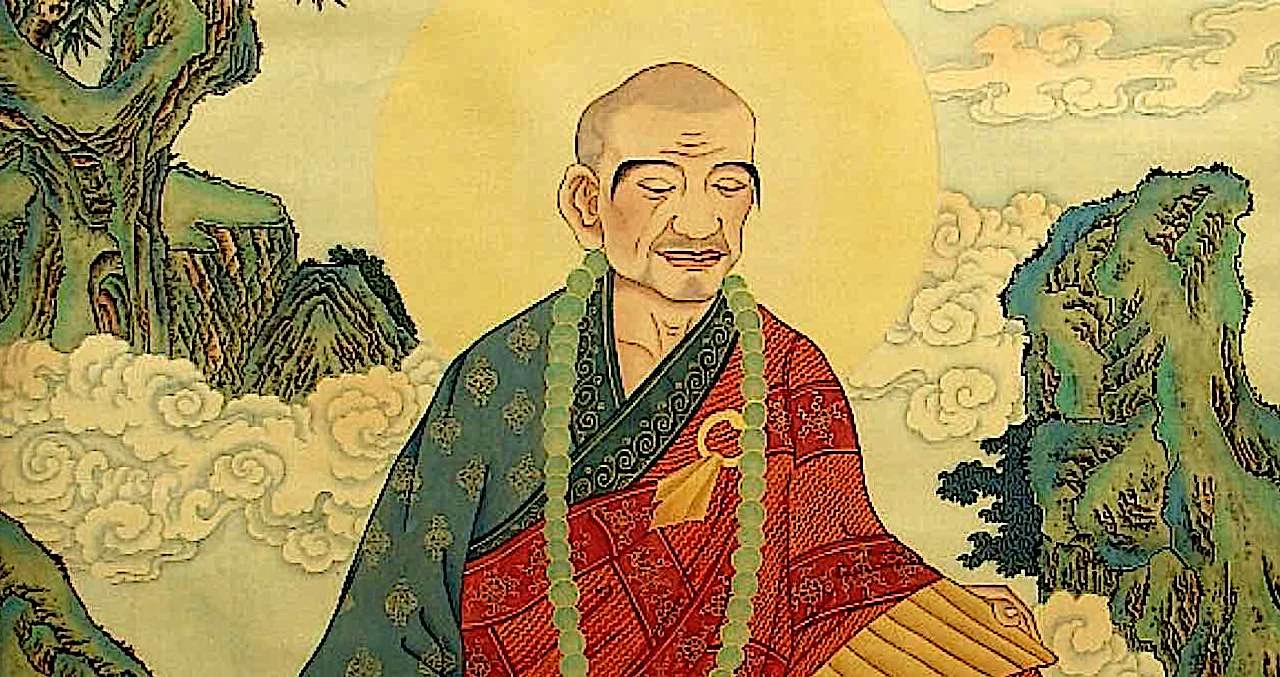
Vasubandhu and Yogācāra Philosophy
Vasubandhu (4th–5th century CE) was one of the most brilliant systematizers in Indian Buddhist history.[1] Initially a master of non-Mahāyāna Abhidharma philosophy, he transitioned to Mahāyāna under the influence of his half-brother Asaṅga, co-founding the Yogācāra (Yoga Practice) school — see Asaṅga and Vasubandhu for the full account of their partnership.[2] Yogācāra fundamentally restructured Buddhist metaphysics by introducing Vijñaptimātra (Appearance-Only), the Eightfold Consciousness model (including the ālayavijñāna), and the Three Natures (trisvabhāva) framework.[3][4] Together, these systems provide a profound phenomenological map of human cognition, suffering, and ultimate liberation.
Biography and Intellectual Transition
-
Historical Context: Vasubandhu lived during the height of northern India's resplendent Gupta Empire.[1:1]
-
The Abhidharma Phase: He began his career within the Sarvāstivāda and Sautrāntika schools, authoring the monumental Abhidharmakośabhāṣya (Treasury of the Abhidharma).[1:2] This text remains the premier sourcebook for pre-Mahāyāna Buddhist psychology and cosmology.[5]
-
Mahāyāna Conversion: According to traditional biographies, his half-brother Asaṅga felt Vasubandhu's unmatched analytical intellect was wasted on non-Mahāyāna "hearsay" and guided him toward the Mahāyāna teachings.[2:1] Upon his conversion, Vasubandhu applied his rigorous philosophical training to formulate the theoretical core of Yogācāra.[2:2]
Core Doctrines of Yogācāra
Yogācāra, also known as Vijñānavāda (the doctrine of consciousness) or Cittamātra (mind-only), shifts the Buddhist inquiry from dry ontological lists of external elements (dharmas) to a deep, meditative analysis of cognitive processing.[6]
Vijñaptimātra (Appearance-Only)
The core philosophical claim of Vasubandhu's Yogācāra is vijñaptimātra.[7]
-
The Claim: What we perceive as "external objects" existing independently of our awareness are actually cognitive representations or projections (vijñapti) arising from mental karma.[7:1]
-
Deconstruction of Duality: Vasubandhu argues that the split between a perceived "outer" object (grāhya) and a perceiving "inner" subject (grāhaka) is a fundamental cognitive error.[7:2] In reality, there is only a unified, dynamic flow of experience.
-
Major Texts: This is systematically defended in his two most famous concise treatises:
The Eightfold Consciousness (Aṣṭavijñāna)
In early Buddhism, consciousness (vijñāna) was divided into six sensory doors. To explain the continuity of karma without an enduring self (ātman), the Yogācāra school — drawing on the Saṅdhinirmocana Sūtra — expanded this to an eightfold scheme:[9]
| Consciousness Level | Sanskrit Name | Function & Characteristics |
|---|---|---|
| 1–5: Active Sensory | Pravṛttivijñāna | Raw sensory data processing (visual, auditory, olfactory, gustatory, tactile).[9:1] |
| 6: Mental Consciousness | Manovijñāna | Synthesizes sensory inputs; conceptualizes, categorizes, and forms deliberate thoughts.[9:2] |
| 7: Afflicted Mind | Kliṣṭamanas | The subconscious seat of ego-clinging. It constantly misinterprets the storehouse consciousness as a permanent "Self."[10] |
| 8: Storehouse Consciousness | Ālayavijñāna | The deep subconscious repository. It stores karmic "seeds" (bīja) deposited by past actions, which later ripen into experience.[11] |
The dynamic loop between the active consciousnesses and the ālayavijñāna is what drives samsara. Actions (1-6) deposit karmic seeds (bīja) into the storehouse (8); these seeds later ripen, conditioning how the active consciousnesses perceive the world, which triggers further karmic actions, repeating the cycle.[11:1]
The Three Natures (Trisvabhāva)
To explain how one transitions from delusion to enlightenment, Vasubandhu utilizes the Three Natures framework, detailed in his Trisvabhāvanirdeśa (Exposition on the Three Natures):[3:1]
-
The Imagined Nature (Parikalpita-svabhāva): The dualistic projection of the world as consisting of permanent, independent subjects perceiving distinct, external objects.[12] This is completely non-existent in ultimate reality.
-
The Dependent Nature (Paratantra-svabhāva): The causally conditioned flow of dependently originated experiences.[13] It is the raw stream of cognitive occurrences, devoid of the dualistic division of "self" and "other."
-
The Perfected Nature (Pariniṣpanna-svabhāva): The ultimate reality, which is simply the dependent nature completely free from the conceptual overlays of the imagined nature.[14] It is things "as they are" (tathatā), experienced non-dually.
In the Trisvabhāvanirdeśa, Vasubandhu explains the Three Natures using the metaphor of a magician conjuring an elephant from a piece of wood using a mantra:[15]
-
The Elephant (the illusion) is the Imagined Nature (parikalpita). It appears real, but there is actually no elephant there.[15:1]
-
The Wood (the causal basis allowing the illusion to appear) is the Dependent Nature (paratantra). Without the wood and the mantra (conditions), the illusion could not occur.[15:2]
-
The Absence of the Elephant in the Wood (realizing the wood is just wood, completely empty of elephant-ness) is the Perfected Nature (pariniṣpanna).[15:3]
Soteriology: Revolution of the Basis (Āśrayaparāvṛtti)
The ultimate goal of Yogācāra practice is not mere intellectual assent, but a fundamental psychic transformation known as the Revolution of the Basis (āśrayaparāvṛtti).[4:1]
-
Through meditative cultivation, the practitioner ceases to project the imagined dualistic reality onto the dependent flow of experience.[4:2]
-
With the cessation of dualistic grasping, the kliṣṭamanas (afflicted mind) relinquishes its self-clinging.[4:3]
-
The ālayavijñāna (storehouse) is emptied of all its defiled, karmic seeds. It ceases to operate as a storehouse of delusion and is "revolutionized" into pure, unblemished wisdom (jñāna), realizing the Dharmakāya of a Buddha.[4:4]
Modern Interpretations: Idealism vs. Phenomenology
Among Western scholars, the precise metaphysical status of Vasubandhu’s Yogācāra is highly debated:[16]
-
Metaphysical/Subjective Idealism: Early Western scholars compared Vasubandhu to George Berkeley, arguing that Yogācāra denies the physical world and posits that only minds exist.[16:1]
-
Epistemological/Phenomenological Interpretation: Contemporary scholars (such as Dan Lusthaus and Jonathan Gold) argue that Vasubandhu is not making an ontological claim that "matter does not exist," but rather a phenomenological claim: we have no access to an unmediated "external" reality; we only ever experience our mental representations of it.[16:2] Therefore, Yogācāra is a therapeutic methodology designed to dismantle cognitive errors rather than a dogmatic idealism.
Backlinks
-
Emanuel Swedenborg — The Yogācāra framework of Imagined, Dependent, and Perfected Natures offers a Buddhist parallel to Swedenborg's layered ontology; the movement from delusion to enlightenment mirrors Swedenborg's spiritual ascent from natural to spiritual understanding.
-
Cetanā and the Karmic Loop in Psychology — This note's detailed exposition of Vasubandhu's Eight Consciousness model, the ālayavijñāna storehouse, and the Three Natures (trisvabhāva) provides the foundational philosophical architecture for the karmic feedback loop in which cetanā operates as the critical pivot point of agency.
References
Jonathan Gold / Vasubandhu / Stanford Encyclopedia of Philosophy ↩︎ ↩︎ ↩︎
Internet Encyclopedia of Philosophy / Vasubandhu / Internet Encyclopedia of Philosophy ↩︎ ↩︎ ↩︎
Jay L. Garfield / Vasubandhu's Treatise on the Three Natures / University of Oslo / NTU Buddhist Library ↩︎ ↩︎
Jochen Althoff / Yogācāra: Path and Liberation / Stanford Encyclopedia of Philosophy ↩︎ ↩︎ ↩︎ ↩︎ ↩︎
Jonathan Gold / Vasubandhu: Biography and Works / Stanford Encyclopedia of Philosophy ↩︎
Jochen Althoff / Yogācāra / Stanford Encyclopedia of Philosophy ↩︎
Jonathan Gold / Major Yogācāra Arguments and Positions / Stanford Encyclopedia of Philosophy ↩︎ ↩︎ ↩︎
Wikipedia Contributors / Triṃśikā-vijñaptimātratā / Wikipedia ↩︎ ↩︎
Jochen Althoff / Yogācāra: The Active Consciousnesses / Stanford Encyclopedia of Philosophy ↩︎ ↩︎ ↩︎
Jochen Althoff / Yogācāra: The Defiled Mind / Stanford Encyclopedia of Philosophy ↩︎
Jochen Althoff / Yogācāra: The Store or Substratum Consciousness / Stanford Encyclopedia of Philosophy ↩︎ ↩︎
Jay L. Garfield / The Three Natures: Parikalpita / University of Oslo / NTU Buddhist Library ↩︎
Jay L. Garfield / The Three Natures: Paratantra / University of Oslo / NTU Buddhist Library ↩︎
Jay L. Garfield / The Three Natures: Parinispanna / University of Oslo / NTU Buddhist Library ↩︎
Jay L. Garfield / Vasubandhu's Treatise on the Three Natures: The Elephant Metaphor / University of Oslo / NTU Buddhist Library ↩︎ ↩︎ ↩︎ ↩︎
Jonathan Gold / Controversy over Vasubandhu as "Idealist" / Stanford Encyclopedia of Philosophy ↩︎ ↩︎ ↩︎