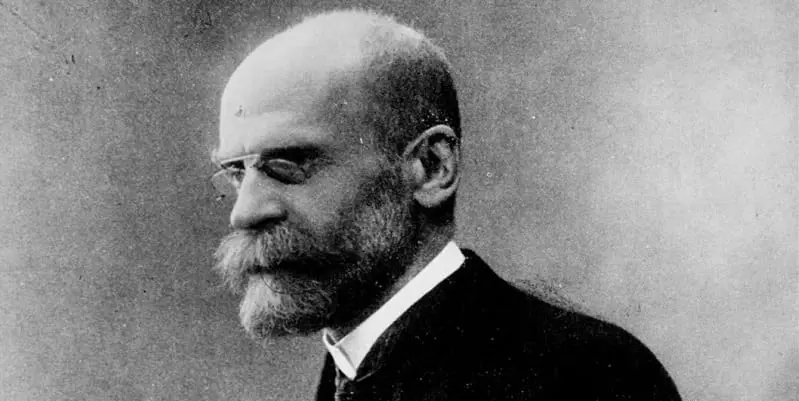
David Émile Durkheim (1858–1917)
Summary
David Émile Durkheim was a French sociologist widely regarded as one of the principal architects of modern social science. He established sociology as an autonomous academic discipline by defining its unique object of study — social facts — and demonstrating that social phenomena could be analyzed with the same rigor as natural phenomena.
Key Contributions
- Social Facts — Ways of acting, thinking, and feeling that are external to the individual and endowed with coercive power.
- Collective Consciousness — The shared beliefs and moral attitudes that unify society.
- Anomie — A state of normlessness resulting from rapid social change or breakdown of social norms.
- The Sacred and the Profane — The foundational distinction of religious life, which functions to reinforce collective solidarity.
- Mechanical and Organic Solidarity — Two forms of social cohesion: mechanical (based on shared beliefs) and organic (based on functional interdependence).
Major Works
- The Division of Labour in Society (1893)
- The Rules of Sociological Method (1895)
- Suicide (1897)
- The Elementary Forms of Religious Life (1912)
Backlinks
- Arnold van Gennep (1873–1957) — Van Gennep's rites of passage framework builds on Durkheim's analysis of ritual and collective solidarity, though Van Gennep was marginalized by Durkheim's sociological school.
- Max Weber (1864-1920) — Weber and Durkheim are the two foundational figures of modern sociology, though their methods differ: Weber's interpretive sociology emphasizes subjective meaning, while Durkheim's positivist approach emphasizes objective social facts.
- Structural Functionalism — Durkheim is the foundational theorist of structural functionalism, providing the core concepts that later theorists systematized.
- The Organic Analogy — Durkheim's organic solidarity refines the organic analogy by showing how modern societies cohere through functional interdependence rather than shared belief.
- The Philosophy of Money (Philosophie des Geldes) — Simmel's analysis of money as a social phenomenon parallels Durkheim's analysis of social facts: both treat economic phenomena as expressions of deeper social structures.
- The Social Construction of Reality - A Treatise in the Sociology of Knowledge — Berger and Luckmann's social constructionism builds on Durkheim's insight that social reality is sui generis — a distinct level of reality that emerges from but cannot be reduced to individual consciousness.